
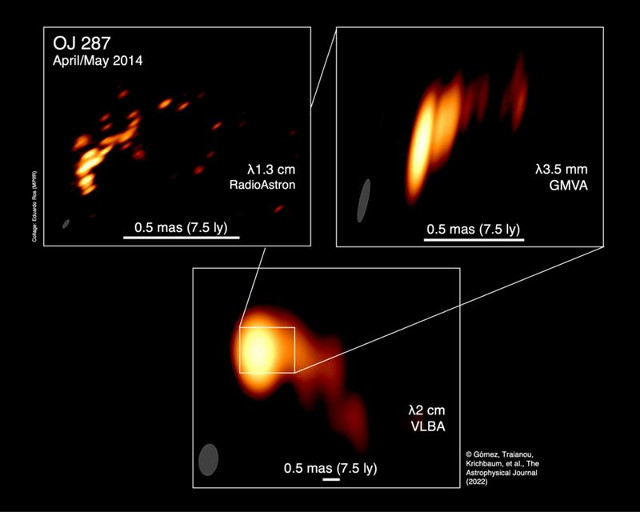
An article published in “The Astronomical Journal” reports observations of the blazar OJ 287 conducted by combining different radio telescopes in various areas of the world and the RadioAstron antenna in space. A team of researchers obtained in this way the highest resolution images obtained so far of OJ 287. They confirm the presence of two supermassive black holes powering the active galactic nucleus, one of the reasons why this blazar has been the focus of many scientists’ interest for a long time.
While supermassive black holes have been a major object of study by astronomers and astrophysicists for a long time, a pair of these extreme objects can only increase that interest. For this reason, the blazar OJ 287 has been studied with different instruments but grasping details of a galaxy about five billion light-years away is difficult. A step forward was made by combining the detections of different radio telescopes.
Very long baseline interferometry (VLBI) is the technique used for this type of combination of instruments around the world. This is the same technique that was used to obtain the historical image of the area around the supermassive black hole at the center of the galaxy M87.
To obtain high-quality images of the blazar OJ 287, twelve radio telescopes were used. The observations conducted with the RadioAstron antenna of the Russian space agency Roscosmos were added. The various radio telescopes conducted their detections at different wavelengths, increasing the quantity and quality of the data obtained.
The image (Courtesy Eduardo Ros/MPIfR (collage), Gómez et al., The Astrophysical Journal, 2022 (images)) shows the blazar OJ 287 observed at different wavelengths by RadioAstron, GMVA, and VLBA, three of the radio telescopes used for this study.
The observations of the blazar OJ 287 show the presence of several emission “knots”, brighter areas in a plasma jet strongly bent in a curvature that is accentuated in the direction of its origin. According to the researchers, that’s a phenomenon consistent with the presence of two supermassive black holes within the galaxy hosting this blazar.
According to previous studies, the blazar consists of one of the largest known black holes with a mass estimated to be about 18 billion times the Sun’s. The other object appears small compared to the primary with a mass that is estimated to be “only” 150 million times the Sun’s. In time, the two black holes should get closer until they finally merge.
The growth of gravitational wave astronomy makes the blazar OJ 287 a possible object of study for future instruments capable of detecting that type of emissions from the pair of supermassive black holes. That’s because their proximity makes emissions of that type likely even if their merger is still very distant in time. OJ 287 is a subject of various types of study, for example for the confirmation of the no-hair theorem, therefore it will continue to be examined with attention.
