
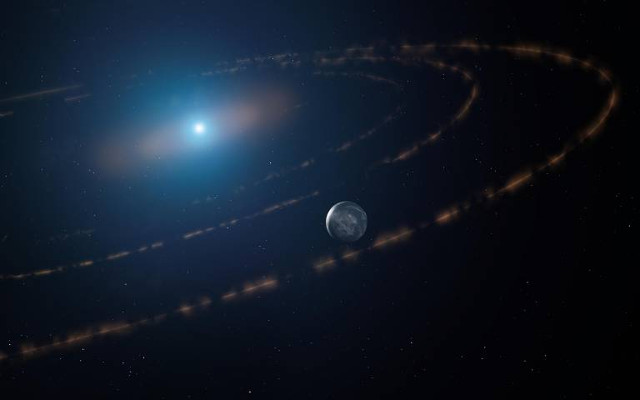
An article published in the journal “Monthly Notice of the Royal Astronomical Society” reports the observation of debris orbiting the white dwarf cataloged as WD1054-226 in a formation that suggests a gravitational bond such as the one which can be generated by a planet. A team of researchers used the ULTRACAM camera mounted on ESO’s NTT telescope at La Silla Observatory in Chile to examine objects that regularly pass in front of those star remnants. Data obtained from NASA’s TESS space telescope helped identify what appears to be a disk of debris that hasn’t dispersed, perhaps thanks to a planet acting as a sort of shepherd that keeps them bound. The planet would be in that system’s habitable area, a special case since it has a white dwarf at its center.
About 117 light-years away from Earth, the white dwarf WD1054-226 is the remnant of a small to medium-sized star at the end of its normal life. A mass comparable to the Sun’s contracts to a volume comparable to the Earth’s. The agony of such a star goes through a red giant phase that can engulf nearby planets and destabilize distant planets. Planets can survive those events but become difficult to detect because a white dwarf is colder and dimmer than a normal star.
It took 18 nights of observations captured by the ULTRACAM camera mounted on the New Technology Telescope (NTT) to find the traces of objects passing in front of the white dwarf WD1054-226 from Earth’s point of view. The researchers found more data on that system among observations conducted by the TESS space telescope, NASA’s current planet hunter. Additional data was collected using the Ultraviolet and Visual Echelle Spectrograph (UVES) instrument mounted on ESO’s Very Large Telescope (VLT) and NASA’s Spitzer Space Telescope.
Analysis of the collected data indicates that there are 65 debris clouds orbiting the white dwarf WD1054-226 every 25 hours. This indicates an orbit in that system’s habitable zone, very close to the star now reduced to a small remnant and much less hot than a normal star. The most pronounced trace of a passage in front of WD1054-226 is also regular, as it occurs every 23.1 minutes.
These traces and their periodicity show a gravitational harmony among the objects present in the system. It suggests the presence of a planet, which has sufficient gravity to maintain a stable bond with other smaller objects. The possible planet was compared to a shepherd that “guides” other objects preventing them from dispersing.
Jay Farihi, the lead author of the article, talked about irregular moon-sized structures that are dusty like a comet. The possible planet wasn’t sighted directly but Farihi explained that without gravitational influence there would be friction and collisions that would cause a dispersion of the other objects with the consequent loss of the regularity detected in their passages. He compared this situation to that of some of the moons of Neptune and Saturn which help maintain the stability of the planetary rings.
A planet in the habitable area of a system with a white dwarf at its center would be an unprecedented discovery. That area was swept when the star was in the red giant phase. That means that the various objects present now arrived there later, following some gravitational “jolt” that occurred during the agony of the white dwarf WD1054-226’s progenitor star. The current situation could remain stable for a very long time, according to researchers even a couple of billion years, so in theory, there’s time for life forms to emerge on a planet even if its star is a white dwarf.
In a few billion years, the Sun will also turn into a white dwarf, so the system of WD1054-226 offers a glimpse at what could be the solar system’s future. The possible presence of a planet in its habitable area makes it even more interesting and will stimulate further studies to verify its existence.
