
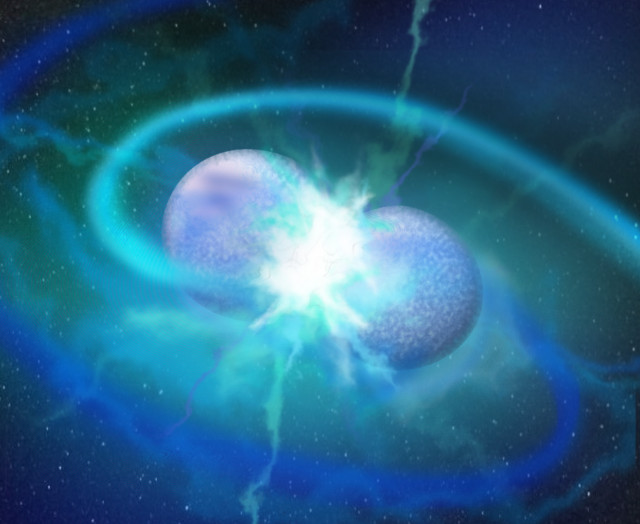
Two articles – available here and here – published in the journal “Monthly Notices of the Royal Astronomical Society: Letters” report different aspects of a study on two anomalous stars, as they’re two subdwarfs that have carbon and oxygen on the surface instead of hydrogen and helium. A team led by Professor Klaus Werner of the German University of Tübingen discovered the two stars, cataloged as PG 1654+322 and PG 1528+025 as part of a research aimed at better understanding the final stages of stellar evolution. A team led by Dr. Miller Bertolam of the Institute of Astrophysics of La Plata, Argentina, offered a possible explanation for the two anomalous stars by explaining in one of two articles that they could have formed as a result of mergers between two white dwarfs.
A white dwarf represents the final phase of the life of a small or medium-mass star, and normally its surface is covered with hydrogen and helium. However, white dwarfs covered in carbon and oxygen have been discovered. According to current models, under some conditions, a white dwarf can have moments of explosive fusion of helium that brings carbon and oxygen to the surface. In the case of PG 1654+322 and PG 1528+025, the conditions are different and not predicted by the models.
In the two subdwarf stars discovered by Professor Klaus Werner’s team, size and temperature indicate a non-explosive helium fusion. The amount of carbon and oxygen produced by that reaction forms about 20% of the mass of the two stars. That helium fusion is what is expected of stars in a more evolved phase of these two.
According to Dr. Miller Bertolam’s team, the characteristics of the two strange subdwarfs PG 1654+322 and PG 1528+025 are derived from white dwarf mergers. Their reconstruction starts from binary systems in which both stars died and turned into white dwarfs which subsequently merged. If one of the two white dwarfs is of the carbon and oxygen-rich type, it could be destroyed by its companion and its remains could cover that companion.
This merger model of white dwarfs with specific characteristics can’t fully explain the existence of PG 1654+322 and PG 1528+025 yet. More work will be needed to improve the model and understand if that kind of merger can really happen. Only in the event of a positive result will it be possible to identify the conditions that can lead to the formation of objects such as the two subdwarfs at the center of these studies.
This type of study is connected to various astronomical topics. The verification of the model based on white dwarf mergers directly concerns the evolution of binary systems. In cases where the two companions are close, they can get closer following the emission of gravitational waves, so there’s an interest in the branch of astronomy that studies these phenomena and is growing. For this reason, we can expect new developments.
