February 2022

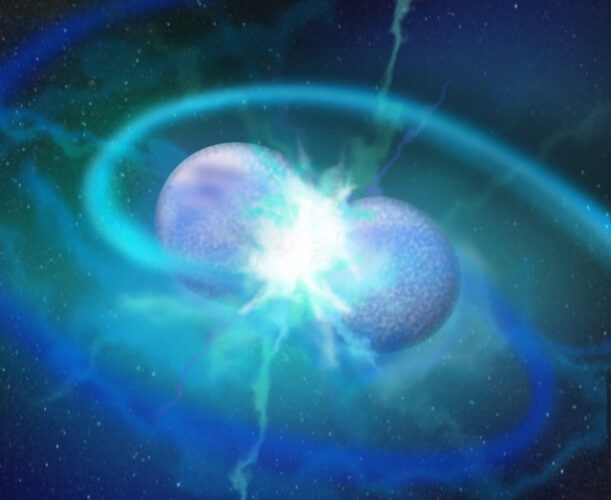
Artist's concept of two white dwarf merging (Image Nicole Reindl (CC BY 4.0))

Two articles published in the journal “Monthly Notices of the Royal Astronomical Society: Letters” report different aspects of a study on two anomalous stars, as they’re two subdwarfs that have carbon and oxygen on the surface instead of hydrogen and helium. A team led by Professor Klaus Werner of the German University of Tübingen discovered the two stars, cataloged as PG 1654+322 and PG 1528+025 as part of a research aimed at better understanding the final stages of stellar evolution. A team led by Dr. Miller Bertolam of the Institute of Astrophysics of La Plata, Argentina, offered a possible explanation for the two anomalous stars by explaining in one of two articles that they could have formed as a result of mergers between two white dwarfs.

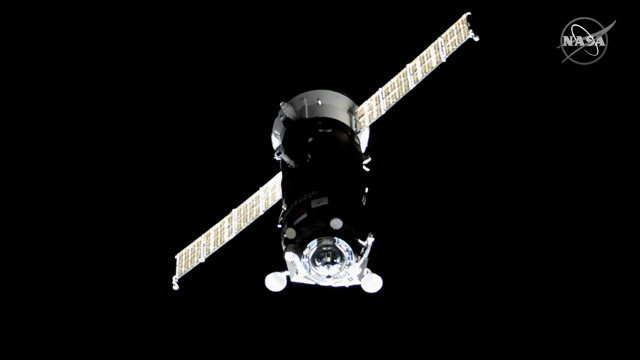
The Progress MS-19 cargo spacecraft blasting off atop a Soyuz-2.1a rocket (Image courtesy Roscosmos)

A few hours ago, the Progress MS-19 spacecraft blasted off atop a Soyuz-2.1a rocket from the Baikonur Cosmodrome in Kazakhstan. After about nine minutes it successfully separated from the rocket’s last stage and was placed on its route. The cargo spacecraft began its resupply mission to the International Space Station also called Progress 80 or 80P. In this mission, the route used is the one that requires about two days.

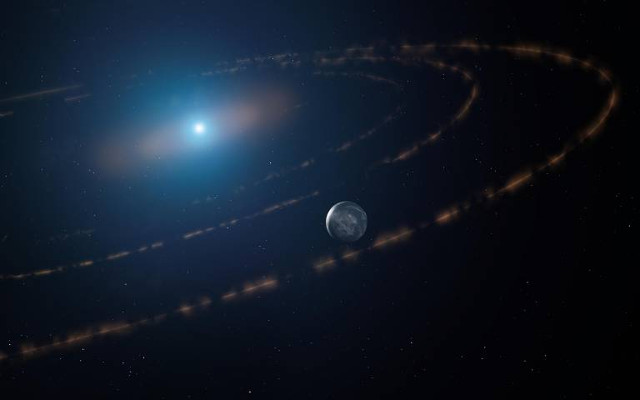
Artist's concept of WD1054-226's system (Image courtesy Mark A. Garlick / markgarlick.com)

An article published in the journal “Monthly Notice of the Royal Astronomical Society” reports the observation of debris orbiting the white dwarf cataloged as WD1054-226 in a formation that suggests a gravitational bond such as the one which can be generated by a planet. A team of researchers used the ULTRACAM camera mounted on ESO’s NTT telescope at La Silla Observatory in Chile to examine objects that regularly pass in front of those star remnants. Data obtained from NASA’s TESS space telescope helped identify what appears to be a disk of debris that hasn’t dispersed, perhaps thanks to a planet acting as a sort of shepherd that keeps them bound. The planet would be in ​​that system’s habitable area, a special case since it has a white dwarf at its center.

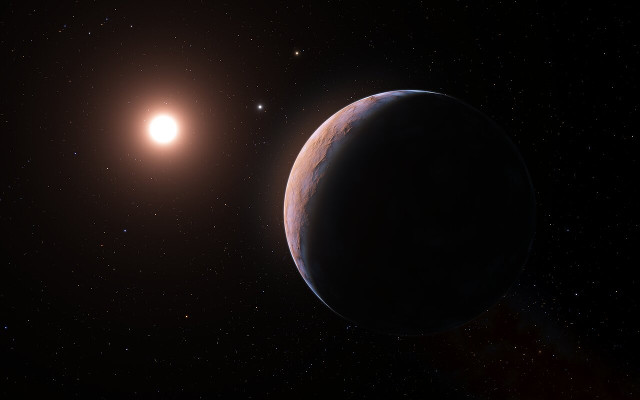
Artist’s impression of Proxima d and Proxima Centauri (Image ESO/L. Calçada)

An article published in the journal “Astronomy & Astrophysics” reports the discovery of another rocky planet in the Proxima Centauri system. A team of researchers led by João Faria of the Instituto de Astrofísica e Ciências do Espaço, Portugal, used detections conducted with the ESPRESSO spectrograph mounted on ESO’s VLT in Chile to find the traces of the planet that was cataloged as Proxima d. This is the exoplanet with the smallest mass identified with the radial velocity method since the estimated minimum mass is about a quarter of the Earth’s, twice Mars’s. Its distance from Proxima Centauri is around 4 million kilometers, so it’s more similar to Venus or Mercury.