
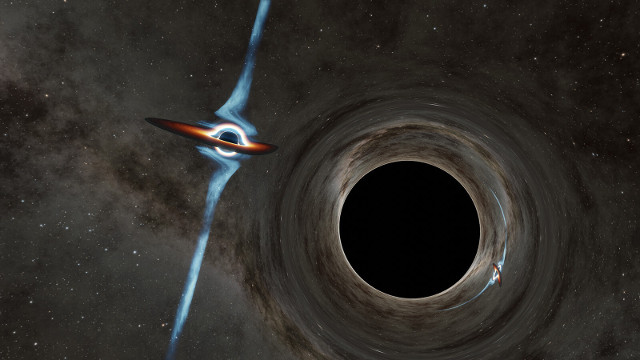
A pair of supermassive black holes may be present in the blazar PKS 2131-021
An article published in “The Astrophysical Journal Letters” reports a study on the blazar cataloged as PKS 2131-021 that offers evidence that it contains a pair of supermassive black holes orbiting each other in a period of two years. A team of researchers used data collected from different telescopes with radio observations going back in time to 1975 to reconstruct what happens inside PKS 2131-021 by exploiting its nature as a blazar. That’s because, by definition, a blazar is powered by a supermassive black hole that emits a jet of materials at very high speeds oriented towards the Earth. The examination of the jet from PKS 2131-021 showed movement caused by the orbital movements of the black hole and a companion around each other. According to the researchers, from the Earth’s point of view, these two supermassive black holes will merge in about 10,000 years.
