
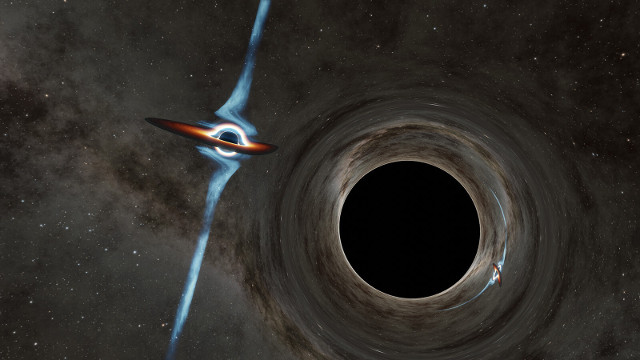
An article published in “The Astrophysical Journal Letters” reports a study on the blazar cataloged as PKS 2131-021 that offers evidence that it contains a pair of supermassive black holes orbiting each other in a period of two years. A team of researchers used data collected from different telescopes with radio observations going back in time to 1975 to reconstruct what happens inside PKS 2131-021 by exploiting its nature as a blazar. That’s because, by definition, a blazar is powered by a supermassive black hole that emits a jet of materials at very high speeds oriented towards the Earth. The examination of the jet from PKS 2131-021 showed movement caused by the orbital movements of the black hole and a companion around each other. According to the researchers, from the Earth’s point of view, these two supermassive black holes will merge in about 10,000 years.
About 9 billion light-years away from Earth, the blazar PKS 2131-021 has been known for decades for its powerful emissions. However, it took many years and studies of blazars and quasars, another type of active galactic nucleus, for astronomers to realize that they are powered by supermassive black holes surrounded by disks of materials. Some of those materials get swallowed and some are ejected into space at speeds close to the speed of light in jets that can extend for thousands of light-years.
This study of the blazar PKS 2131-021 began with observations conducted in 2008 when Tony Readhead, now a professor at CalTech, and various colleagues used the CalTech’s Owens Valley Radio Observatory (OVRO) radio telescope to study the relativistic jets of supermassive black holes. The monitoring of more than 1,000 blazars led to the collection of a lot of data over the years and in 2020 led to noting that PKS 2131-021’s emissions had sinusoidal variability. This led to broadening the investigation of this specific blazar to look for more light curves of this blazar.
Data from the Very Long Baseline Array and UMRAO (Michigan Radio Astronomy Observatory) showed light curves in previous years that matched the ones already observed by Tony Readhead and his colleagues. However, the big leap forward came thanks to Sandra O’Neill, first author of the new study and Readhead’s student at CalTech, who in 2021 began a collaboration with her professor offering crucial contributions to the discovery of further data on PKS 2131-021 dating back to previous years.
A research in the astronomical archives led to the discovery of observations of the blazar PKS 2131-021 conducted at the Haystack Observatory between 1975 and 1983. Their examination showed a peak in the light curve in 1976 that matched Tony Readhead and his colleagues’ predictions.
Detecting changes in the jet from the blazar PKS 2131-021 was made more difficult by the fact that there were no peaks for about twenty years. Tony Readhead compared it to a ticking clock in which each cycle of the sinusoidal wave corresponds to a two-year orbit of the two supermassive black holes around each other. According to Readhead and his colleagues, the 20-year gap is due to some variation in PKS 2131-021’s feeding. The activity of an active galactic nucleus can be erratic because it depends on the amount of material around the supermassive black hole that powers it.
According to the researchers, the two supermassive black holes in the blazar PKS 2131-021 have masses of several hundred million times the Sun’s. Recently, another team of researchers presented evidence of a similar pair in the blazar OJ 287 but the black holes in PKS 2131-021 are even closer and will merge first from the Earth’s point of view.
The gravitational waves emitted by supermassive black holes such as those of the two blazars object of these studies have frequencies lower than those detectable by the LIGO and Virgo instruments, used in gravitational-wave astronomy. This branch of astronomy has just been born and in the next few years instruments that are sensitive to gravitational waves emitted by supermassive black holes as well could come into service. This will make it possible to obtain new information on these extreme objects.
