
An article accepted for publication in “The Astrophysical Journal Letter” reports a study based on the X-ray emissions from the kilonova generated by the merger of two neutron stars in the event detected by gravitational waves on August 17, 2017, and cataloged as GW170817. A team of researchers used observations conducted with NASA’s Chandra X-ray Observatory in the years following the first detection to monitor the evolution of the kilonova’s remnants. So far, this is the only kilonova identified with certainty and it was detected at both electromagnetic and gravitational waves but there’s still no certainty of what was produced by the GW170817 event. The X-ray emissions could indicate that a black hole was born but they could be emissions that are a kind of afterglow of the kilonova.
The GW170817 event is one of those that have been marking astronomy in recent years but the extent of its influence is not yet clear. That’s because such a wealth of data was collected in the period immediately following the kilonova that it will take a long time to examine it thoroughly. The consequences of that event continue to be observed because the X-ray emissions continued, albeit in they’re not steady.
NASA’s Chandra X-ray Observatory is among the instruments used to monitor the X-ray emissions from the kilonova area in the galaxy NGC 4993. The X-ray levels decreased between March 2020 and the end of 2020 and at that point that decline stopped, leaving constant levels. Rafella Marguitti of the University of California at Berkeley, one of the authors of this study, explained that the fact that the X-ray levels stopped decreasing is the best evidence that there’s something besides the jet of materials emitted by the kilonova to generate them. Identifying the new source would help to understand the processes taking place and what was generated by the merger of two neutron stars.
The constant X-rays emitted today could be generated by the shock wave created following the collision of the debris of the merger between neutron stars and the surrounding gas. That collision could be so violent that it generates electromagnetic emissions so intense that they reach the X-ray band. That’s a phenomenon that was compared to the sonic boom generated by an airplane that goes beyond the speed of sound.
An alternative explanation is that the X-rays are emitted by materials falling towards a black hole generated by the merger between the two neutron stars. Before being swallowed, those materials would be accelerated and heated to the point of generating electromagnetic emissions in the X-ray band.
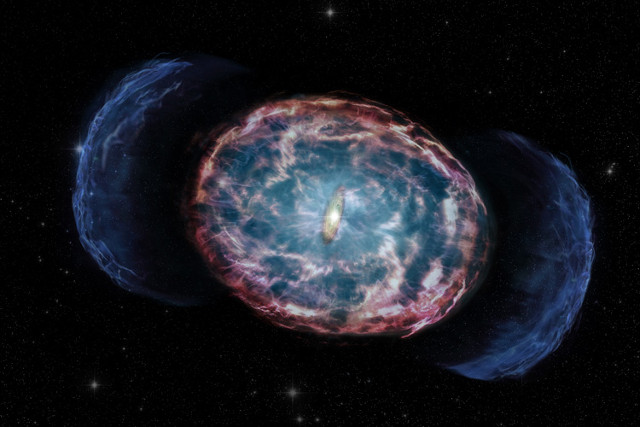
The image (X-ray data from NASA, CXC and Northwestern Univ./A. Hajela; visual by NASA/CXC/M. Weiss) shows an artistic representation in which the merger of two neutron stars forms a black hole hidden in the bright area at the center of the image. The jets of particles in blue could be generated by the black hole and could be the X-ray sources. They could be produced by the shock wave of materials around the black hole or by materials falling into the black hole, indicated with yellowish hues in the area around the central one.
According to the researchers, it will still take some time to establish which of the two explanations for the origin of the X-rays detected by the Chandra X-ray Observatory is correct. That’s because electromagnetic emissions will change differently depending on their origin. If it’s the afterglow of the kilonova, the big difference will be detectable in the radio band, in which the emissions will increase over time. If the origin is in a black hole, the radio emissions will cease while the X-ray emissions will depend on the materials around the central area, so they could remain stable or decrease rapidly.
Many researchers are studying the GW170817 event and its consequences from various points of view. The consequences of that merger of neutron stars are still to be understood, starting with the nature of the object produced. It’s the first event of this type identified with certainty, so the study of its remnants’ evolution will continue for many years.
