An article published in the journal “Nature” reports a study on the Milky Way’s formation that provides evidence that the part known as the thick disc started forming about 13 billion years ago, 2 billion earlier than previously thought. Maosheng Xiang and Hans-Walter Rix of the Max-Planck Institute for Astronomy, Heidelberg, Germany, used data collected by ESA’s Gaia space probe and observations conducted with the LAMOST telescope to reconstruct the Milky Way’s formation and evolution phases. In particular, the researchers focused on the period between 13 and 8 billion years ago, when there were galactic mergers and a lot of hydrogen was consumed in a phase of remarkable star formation.
Reconstructing the history of the Milky Way is an important astronomical goal. Much progress has been made in recent years thanks to a sharp increase in the quantity and quality of available data. Despite this, there were still rough estimates of the age of the stars due to still inaccurate data which meant margins of error of up to 40% which consequently could exceed a billion years.
The Gaia space probe is a special space telescope that is mapping the sky accumulating data with a remarkable increase in quantity and quality. Maosheng Xiang and Hans-Walter Rix used data published in the so-called EDR3 (Early Data Release 3), an intermediate release between two of the major publications that took place on March 12, 2020. The data from Gaia offers information on star brightness and position. The Chinese LAMOST (Large Sky Area Multi-Object Fiber Spectroscopic Telescope) allows to measure the chemical composition of stars by analyzing their electromagnetic emissions to find the chemical signatures from the various elements.
The two researchers combined data from Gaia and LAMOST on about 250,000 stars scattered around the galaxy, sub dwarfs in which the nucleus has stopped generating energy through nuclear fusion, which is instead active in the envelope around the nucleus. That’s a phase in which the star is turning into a red giant and is short, so it helps to accurately determine the star’s age.
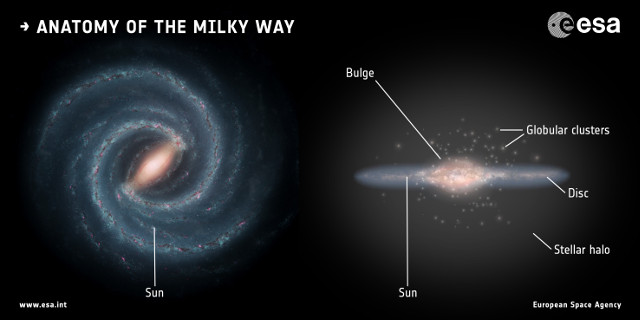
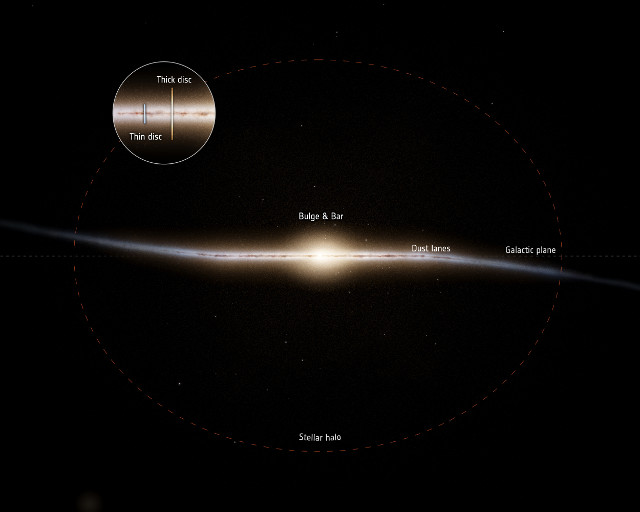
Complex calculations based on the information collected made it possible to obtain much more precise estimates than in the past of the examined stars’ age with some surprises. Astronomers already knew that the Milky Way is made up of several components with differences mainly between the stellar halo (see bottom image, courtesy left: NASA / JPL-Caltech; right: ESA; layout: ESA / ATG medialab) and the disc. The disc is divided into two parts: the thin disc and the thick disc (see top image, courtesy Stefan Payne-Wardenaar / MPIA). The thin disc contains most of the stars we see while the thick disc is over twice as thick but has a much smaller radius. The age differences of these areas show the different stages in the Milky Way’s history.
The new estimates indicate that the first phase of the Milky Way’s history began “only” 800 million years after the Big Bang, with the formation of stars in the thick disc. This new estimate anticipates the start of star formation by about 2 billion years compared to previous estimates. It’s possible that the inner parts of the halo started coming together at that stage but the process accelerated about 2 billion years later when the Gaia-Sausage-Enceladus dwarf galaxy merged with the Milky Way. Star formation in the thick disc continued until about 6 billion years after the Big Bang.
This result is among the ones that show the usefulness of the work that the Gaia space probe is still carrying out. On June 13, 2022, ESA is scheduled to publish the final version of DR3 (Data Release 3), which will also include spectral data and derived information on stars’ age and chemical composition. This will make it easier to extend the type of work being conducted for this study. ESA’s work with Gaia will not be finished because DR4 (Data Release 4) is expected to be published in 2024, a further step forward.
Other astronomical surveys could provide more data, so it’s possible that in the coming years, the work of reconstructing the Milky Way’s history will take a leap forward. Extending studies such as the one conducted by Maosheng Xiang and Hans-Walter Rix will help to understand that story in its complexity, which includes stellar mergers.