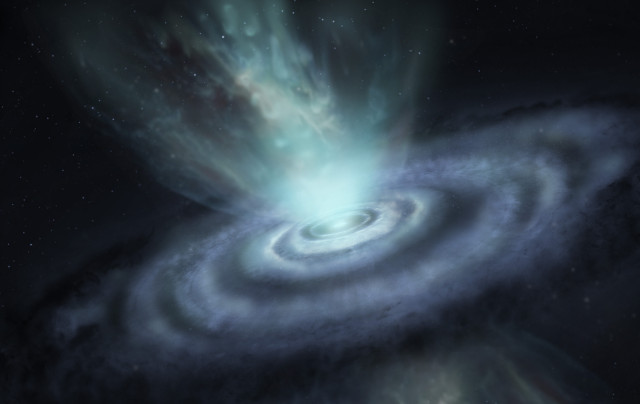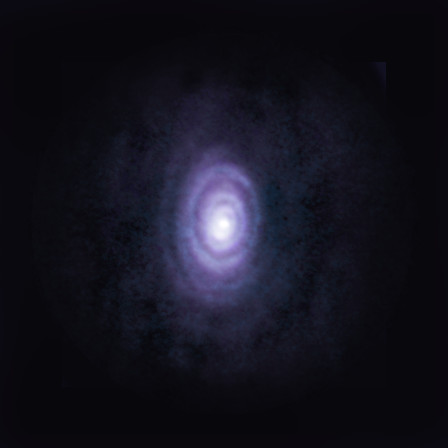
An article accepted for publication in “The Astrophysical Journal” reports the results of a study of the star V Hydrae that includes the discovery of a system of six rings that surround it and are expanding and two hourglass structures. A team led by Raghvendra Sahai of NASA’s JPL used the ALMA radio telescope and data collected with the Hubble Space Telescope to study the materials that were ejected by V Hydrae in the agony that will lead to its death. These observations can provide valuable information to better understand the processes taking place during a relatively short phase that for this reason is difficult to observe.
About 1,300 light-years from Earth, V Hydrae is a carbon star, a red giant with a strong presence of carbon in its atmosphere. To be precise, it’s part of the so-called asymptotic giant branch (AGB), typical for stars of small and medium mass. This means that in a few billion years the Sun will also pass through this phase, which has an estimated duration of a few hundred thousand years. It’s a short time from an astronomical point of view, so it’s difficult to find a star in that phase. This means that V Hydrae is particularly interesting and for this reason, it has already been the subject of various studies.
An article published in “The Astrophysical Journal” in August 2016 reported the ejection of huge plasma bubbles by the star V Hydrae, studied using the Hubble Space Telescope. Raghvendra Sahai, Samantha Scibelli, and M. R. Morris, the authors of this article, continued to study this star together with other colleagues also using the ALMA (Atacama Large Millimeter/submillimeter Array) radio telescope, inaugurated in March 2013.
In the study published in 2016, the researchers offered evidence of the presence of a companion of V Hydrae that is invisible from Earth to explain the ejection of plasma bubbles. Now Raghvendra Sahai explains that that companion may be at least partially responsible for other newly discovered ongoing processes. He also added that traditional models of AGB stars are incomplete and may be wrong.
The ALMA radio telescope made it possible to exploit the abundance of carbon around the star V Hydrae to map the diffusion of its various isotopes it created and ejected. This made it possible to discover the existing structures in the area with the concentric rings, which the researchers called DUDE (Disk Undergoing Dynamical Expansion), clearly visible. There are also two hourglass-shaped structures of the type already seen in young emission nebulae that are expanding at a very high speed estimated at around 240 kilometers per second.
It took a powerful and sensitive instrument like ALMA to achieve these results. Data collected with the Hubble Space Telescope added to ALMA’s offers a more complete picture of the star V Hydrae’s status. These results confirm how interesting it is to understand the last phases of the life of stars of small and medium mass and therefore of the Sun as well. In the case of V Hydrae, the studies will continue, also in the search for the companion, which could be a small star whose light is so dim that it’s obscured by V Hydrae or perhaps a brown dwarf, an object between star and planet, even more difficult to detect.