
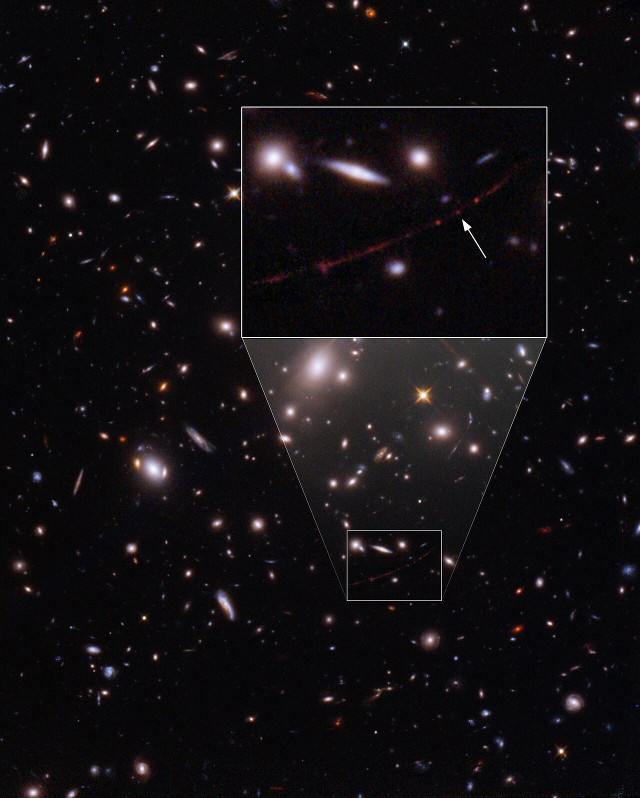
An article – link to a file in PDF format – published in the journal “Nature” reports the discovery of the most distant single star, nicknamed Earendel. A team of researchers used data collected during the RELICS (Reionization Lensing Cluster Survey) program using the Hubble Space Telescope to search for the brightest galaxies dating back to the first billion years of the universe’s life. A large galaxy cluster cataloged as WHL0137-08 distorted the image of very distant galaxies in a gravitational lensing effect to the point that it can detect a single star about 12.9 billion light-years away from Earth. Earendel’s study, whose mass was estimated to be at least 50 times the Sun’s, will help to better understand the formation and evolution of the very first generations of stars in the universe.
In April 2018, the announcement of the detection of a single star so distant that we see it as it was when the universe was about 4.4 billion years old made a sensation. Identifying a single star billions of light-years away is truly an extraordinary feat and that was another case it was possible thanks to a galaxy cluster that generated a gravitational lens. The star nicknamed Earendel, an Old English term meaning morning star, is much farther away.
The exceptional discovery was only possible thanks to the lucky combination between the gravitational lens generated by the galaxy cluster WHL0137-08 and the presence of a very massive and therefore extremely bright star like Earendel in a primordial galaxy just behind the cluster from the Earth’s point of view. The estimate of Earendel’s mass is approximate but it should be at least 50 times the Sun’s and this means that it’s millions of times brighter than the Sun. That brightness is increased a thousandfold or more by the gravitational lens allowing us to see it even from the Earth.
An ancient star like Earendel should be made up almost only of hydrogen and helium because at the time there was also some lithium and only traces of heavier elements generated by the first generation of stars in the universe. Earendel could even be part of the first generation, the one called Population III, but that’s unlikely.
Brian Welch of Johns Hopkins University, lead author of the article, explained that studying Earendel will open a window into an era of the universe that we’re not familiar with that led to everything we know. He compared this situation to reading an interesting book we started from the second chapter of which we now have a chance to read the beginning.
It’s possible that Earendel has a companion because very massive stars are usually part of binary or even multiple systems. However, spotting this star required a very lucky combination, so finding a companion that might be much smaller is nearly impossible.
The scientific mission of the James Webb Space Telescope will finally begin in the coming months and Earendel certainly represents an interesting target. Webb’s sensitivity to infrareds makes it even more ideal for studying objects so far away whose light is distorted to the point that its emissions’ wavelengths are highly shifted towards that electromagnetic band.
According to the researchers, the lucky alignment that allowed Earendel to be identified is expected to continue for years to come. This means that the James Webb Space Telescope will be able to study this star for a long time to provide more precise data on its nature. Even if it wasn’t a first-generation star, it’s so ancient that it will surely provide interesting information on star formation and evolution when the universe was very young.
