March 2022

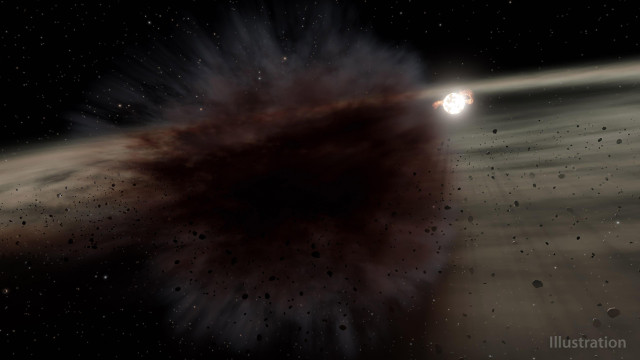
Artist's concept of a cloud of debris in the system of the star HD 166191 (Image NASA/JPL-Caltech)

An article published in “The Astrophysical Journal” reports a study on the star system cataloged as HD 166191, which has an estimated age of 10 million years and is still in its formation process with objects that form but also get destroyed following collisions. A team of researchers led by Kate Su of the University of Arizona used data collected between 2015 and 2019 using NASA’s Spitzer Space Telescope and ground-based telescopes to detect traces of debris clouds generated by collisions between planetesimals. The information obtained from these data is very useful to improve our knowledge of the formation and evolution of planetary systems.

The Soyuz MS-21 spacecraft (at the center) docked with the International Space Station (Image NASA TV)

A few hours ago, the Soyuz MS-21 spacecraft was launched from the Baikonur Cosmodrome in Kazakhstan and after a little more than three hours reached the International Space Station with three new crew members on board. It docked with the Station’s Prichal module. As is becoming increasingly common for crewed trips as well, the ultra-fast track was used which halves the journey duration.

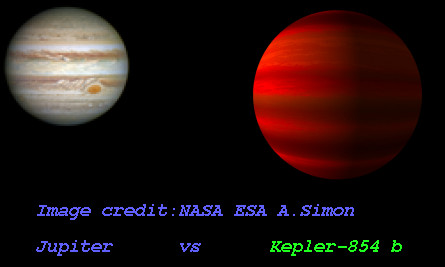
Artist's concept of Kepler-854b as en exoplanet compared to Jupiter

An article published in “The Astronomical Journal” reports a study that reviews the data of four objects discovered a few years ago thanks to NASA’s Kepler space telescope, concluding that at least three of them are actually tiny stars and not planets. A team of researchers used new data collected by ESA’s Gaia space probe to get more precise information on objects cataloged as exoplanets. Kepler-854b, Kepler-840b, and Kepler-699b appear to have sizes between two and four times Jupiter’s, too much even for hot Jupiters very close to their stars but possible for tiny stars. Kepler-747b turns out to have a radius 1.8 times Jupiter’s even though it’s quite far from a star a little smaller than the Sun, so its nature is uncertain.

The pulsar j2030 and part if its filament seen at X-rays and optical frequencies

An article accepted for publication in “The Astrophysical Journal” reports a study on the long filament generated by the pulsar cataloged as PSR J2030+4415, or simply J2030. Martjin de Vries and Roger Romani of the American Stanford University used observations made using NASA’s Chandra X-ray Observatory and ground-based telescopes to study a filament that has an estimated length of about 7 light-years and is composed of matter but also of antimatter. Pulsar emissions of this type could explain positron detections in the Milky Way.

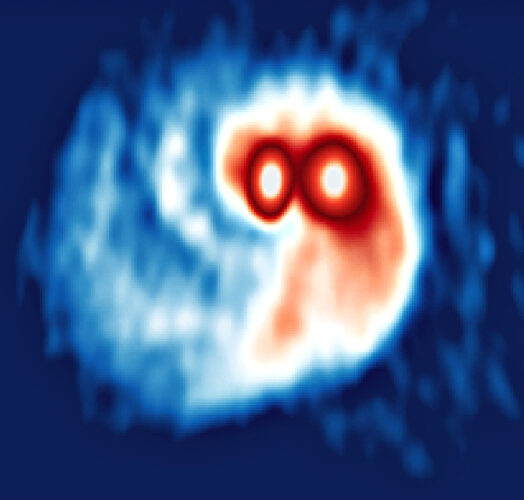
The SVS 13 system seen by ALMA

An article accepted for publication in “The Astrophysical Journal” reports a study on the binary system cataloged as SVS 13, consisting of two protostars surrounded by disks of materials that could lead to the formation of planets. A team of researchers used thirty years of observations conducted with the VLA and new observations conducted with the ALMA radio telescope to obtain a detailed picture of the situation. The conclusion is that each of the two protostars has its own circumstellar disk and that there’s a third disk of the circumbinary type that orbits both stars. The analysis of the data also led to the identification of nearly thirty molecules in the SVS 13 system including thirteen complex organic molecules precursors of life.