March 2022

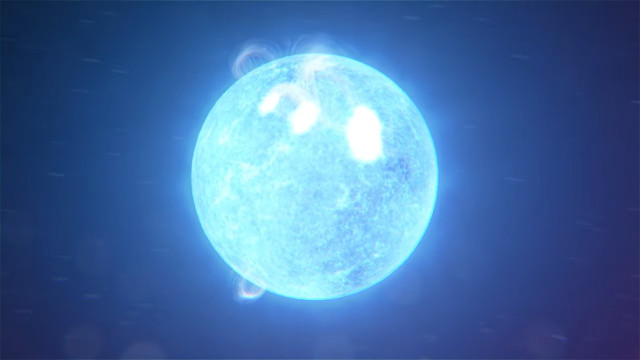
Artist's representation of the magnetar SGR 1830 and its spots (Image NASA's Goddard Space Flight Center)

An article published in “The Astrophysical Journal Letters” reports a study on the magnetar cataloged as SGR 1830-0645, or simply SGR 1830, and spots on its surface that generated X-ray emissions. A team of researchers used the NICER telescope installed on the International Space Station to monitor the outbursts on the surface of SGR 1830 and the merger of three spots into one. More data was collected thanks to NASA’s Swift Space Telescope. The conclusion is that this is an activity that has similarities with the movements of tectonic plates on Earth. The magnetic field of the magnetar can cause its surface to deform, crack, and even melt even though it’s extremely hard. Spots are areas where Sun-like coronal loops connect to the surface.

Some of the images captured by the ACS instrument (Image NASA, ESA)

NASA and ESA celebrated the 20th anniversary of the installation of the Hubble Space Telescope’s ACS (Advanced Camera for Surveys) instrument with the publication of some images among the more than 125,000 captured during these twenty years of service. On March 7, 2002, astronauts James Newman and Mike Massimino installed the ACS during the space shuttle Columbia’s STS-109 mission. This instrument made a significant contribution to a lot of extraordinary astronomical research conducted using Hubble.

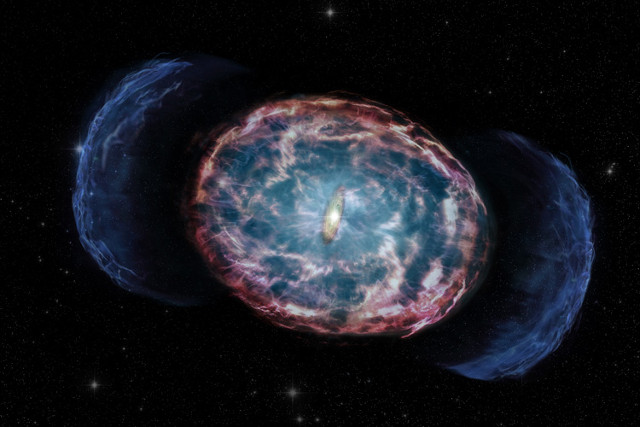
Artist's representation of the evolution of the GW170817 kilonova

An article accepted for publication in “The Astrophysical Journal Letter” reports a study based on the X-ray emissions from the kilonova generated by the merger of two neutron stars in the event detected by gravitational waves on August 17, 2017, and cataloged as GW170817. A team of researchers used observations conducted with NASA’s Chandra X-ray Observatory in the years following the first detection to monitor the evolution of the kilonova’s remnants. So far, this is the only kilonova identified with certainty and it was detected at both electromagnetic and gravitational waves but there’s still no certainty of what was produced by the GW170817 event. The X-ray emissions could indicate that a black hole was born but they could be emissions that are a kind of afterglow of the kilonova.

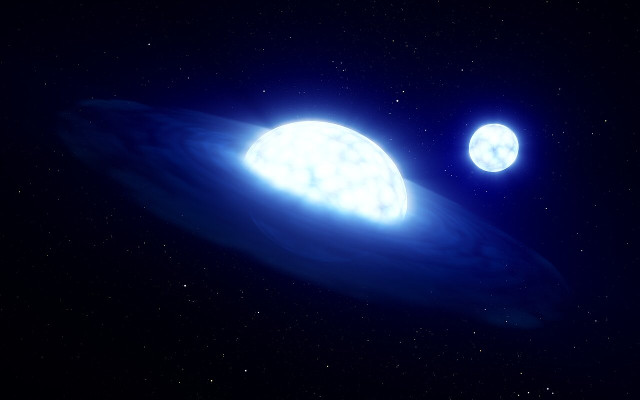
The HR 6819 system in the new interpretation of the data (Image ESO/L. Calçada)

An article published in the journal “Astronomy & Astrophysics” reports a new study on the HR 6819 system that offers a more convincing explanation than the one proposed in 2020, when the presence of a black hole was proposed as part of a triple system. A team of researchers led by Abigail Frost of Ku Leuven, Belgium, which includes members of the team that claimed the black hole’s presence and members of the team that already offered an alternative explanation, used new observations obtained with ESO’s VLT that include the use of the VLTI interferometer to try to get a final answer. The conclusion is that HR 6819 is a binary system in which there is no black hole but there is a phenomenon of stellar vampirism in which one of the two stars has torn large quantities of hydrogen from its companion.

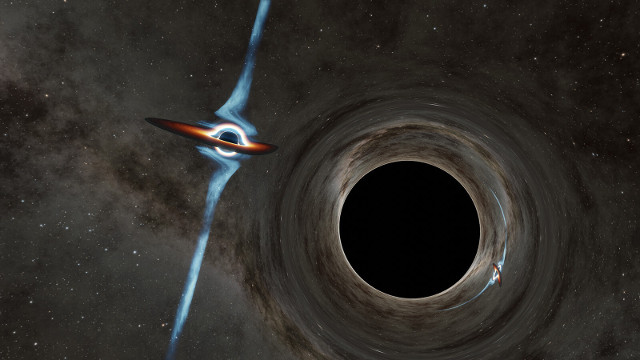
Artist's concept of the blazar PKS 2131-021 with its pair of supermassive black holes (Image courtesy Caltech/R. Hurt (IPAC))

An article published in “The Astrophysical Journal Letters” reports a study on the blazar cataloged as PKS 2131-021 that offers evidence that it contains a pair of supermassive black holes orbiting each other in a period of two years. A team of researchers used data collected from different telescopes with radio observations going back in time to 1975 to reconstruct what happens inside PKS 2131-021 by exploiting its nature as a blazar. That’s because, by definition, a blazar is powered by a supermassive black hole that emits a jet of materials at very high speeds oriented towards the Earth. The examination of the jet from PKS 2131-021 showed movement caused by the orbital movements of the black hole and a companion around each other. According to the researchers, from the Earth’s point of view, these two supermassive black holes will merge in about 10,000 years.