
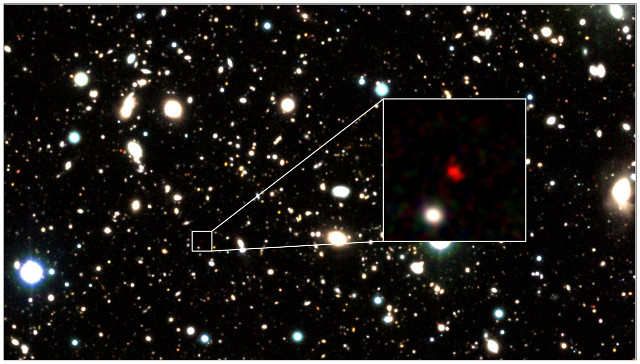
An article published in “The Astrophysical Journal” reports the discovery of what could set the new record for the most distant known galaxy. A team of researchers used various telescopes to observe this object, cataloged as HD1, whose distance has been estimated to be about 13.5 billion light-years from Earth.
In another article, published in the journal “Monthly Notices of the Royal Astronomical Society Letters”, some of the researchers offer some theories about HD1. It could be a so-called starburst galaxy with an extraordinary star formation star which could include the first generation of stars in the universe or a quasar powered by the oldest known supermassive black hole.
HD1 was discovered by examining over 1,200 hours of observations conducted with the Subaru telescope, the VISTA telescope, the UK Infrared Telescope, and the Spitzer Space Telescope. This means that it was found among over 700,000 objects and only because it’s very bright, particularly in ultraviolet light.
The researchers conducted follow-up observations using the Atacama Large Millimeter/submillimeter Array (ALMA) radio telescope, inaugurated in March 2013, which made it possible to make a fairly precise estimate of the distance of HD1, whose red color immediately showed the characteristics of a very ancient galaxy.
All the data collected indicates that HD1 is about 13.5 billion light-years away from Earth. This means that this object was formed about 300 million years after the Big Bang. It’s a primordial galaxy but its distance requires greater precision to confirm it beyond any reasonable doubt. If confirmed, it’s the most distant known object surpassing the record held by the galaxy GN-z11, whose discovery was reported in 2016 and is at the Hubble Space Telescope’s detection limits.
HD1 is so distant that it’s very difficult even to establish its nature. Fabio Pacucci of the Center for Astrophysics | Harvard & Smithsonian (CfA), lead author of the article published in “The Astrophysical Journal”, explained that its ultraviolet brightness indicates that it was generated by very energetic processes but for now there are only theories to explain them because the current quality of the observations doesn’t allow precise interpretations.
The so-called starburst galaxies have a high star formation rate but that of HD1 should be over 100 stars born every year, at least 10 times higher even than starburst galaxies. However, if we were dealing with first-generation stars, very massive and formed almost only of hydrogen and helium, their extreme brightness could be out of the ordinary at ultraviolet as well.
Another possibility is that HD1 is a quasar, which would mean it has an active galactic nucleus powered by a supermassive black hole that should have a mass of about 100 million times the Sun’s. By devouring large quantities of gas that approach and are heated to the point of generating very strong electromagnetic emissions even at ultraviolet rays, it would be the oldest known supermassive black hole. The fact that a black hole of this mass formed so early in the history of the universe would make it extraordinary.
Confirming the distance of HD1 is important in order to offer more accurate assessments of its nature. A candidate for the record of the most distant known galaxy is certainly interesting for follow-up observations with the James Webb Space Telescope, which is scheduled to begin its scientific mission, at last, in summer 2022. Understanding the origin of its brightness will help better understand the early universe.
