
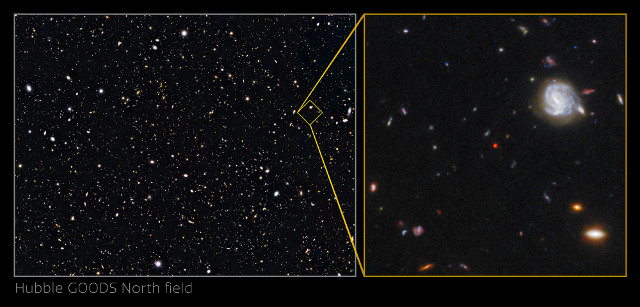
A probable supermassive black hole precursor discovered
An article published in the journal “Nature” reports the discovery of a possible precursor of a supermassive black hole in the early universe. A team of researchers discovered the object cataloged as GNz7q in the data of the GOODS survey conducted by combining observations made with different telescopes. From Earth, we see GNz7q as it was about 750 million years after the Big Bang and its emissions can only be partially explained by a remarkable star formation. The conclusion is that there’s probably a supermassive black hole growing within the dust that fills up the primordial galaxy’s nucleus and over time it will become a quasar, a type of extremely bright active galactic nucleus.
