
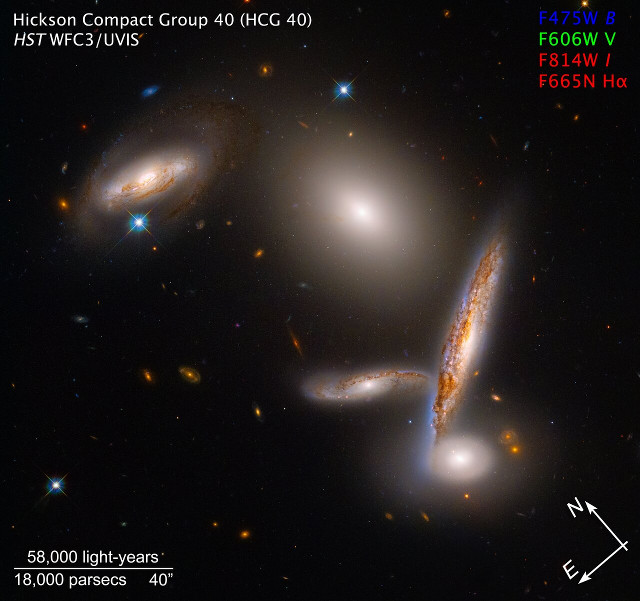
April 25, 2022, will mark the 32nd anniversary of the Hubble Space Telescope’s deployment into orbit, and to celebrate it, NASA and ESA have published images of a quintet of galaxies known as Hickson Compact Group 40 (HCG 40). This group of three spiral galaxies, one elliptical galaxy, and one lenticular galaxy is interesting for a number of reasons including the fact that within about a billion years they are predicted to collide and start merging.
In 1982, astronomer Paul Hickson published a catalog of one hundred compact groups of galaxies. These are concentrations of various galaxies that can be considered part of galactic clusters due to gravitational bonds and at the same time be distant from other galaxies in their cluster.
In the case of Hickson Compact Group 40 (Image NASA, ESA and STScI), there are five isolated galaxies that are close enough to occupy a region of space that is less than twice the Milky Way’s diameter. That’s a remarkable density even by the standards of these compact groups, and the reasons behind such a compact grouping are unclear.
A possible explanation for the proximity of this group’s galaxies is a remarkable presence of dark matter that permeates that region of space. This would greatly increase the force of gravity that draws these galaxies towards each other and at the same time slow down their other movements. That’s why astronomers believe that within a billion years or so, they will collide and slowly merge into one giant galaxy.
To try to understand the state of Hickson 40 Compact Group’s galaxies and their evolution, they have been the subject of various studies over time. The Hubble Space Telescope can only detect emissions in some bands of the electromagnetic spectrum but those galaxies have been observed with other instruments in other bands such as radio waves and X-rays. The set of detections suggests the presence of supermassive black holes at the center of those galaxies and offers information on star formation within them.
Probably, such compact groups of galaxies were more abundant in the early universe but over time they turned into single giant galaxies. Galaxy mergers are common events, and various stages of the merger process have been observed in much more recent times.
The wait for the beginning of the collision between Hickson Compact Group 40’s galaxies is too long from a human point of view but their study is nevertheless interesting to better understand various phases of galaxy evolution. They will keep on being observed within dark matter studies as well to improve models on this still mysterious type of matter and to test alternative models that try to explain the observed effects without its existence.
