
An article published in “The Astrophysical Journal” reports the results of a study conducted on 108 galaxies containing nuclear star clusters in search of intermediate-mass black holes. A team of researchers used NASA’s Chandra X-ray Observatory to look for the traces of this type of black hole that has so far been very elusive. In 29 of these galaxies, they found emissions they believe came from this type of black hole and traces of the destruction of thousands of stars. This suggests that intermediate-mass black holes grow by devouring stars.
Various theories link the formation of intermediate-mass black holes to conditions that existed only in the early universe. In that case, they may have been the “seeds” of supermassive black holes, which can reach masses up to billions of times the Sun’s. However, a group of researchers tried to look for them in nuclear star clusters, a type of star cluster marked by high density and brightness near the center of galaxies. This choice is due to the conditions existing in those clusters, which have a density that allows black holes to devour large quantities of materials torn from nearby stars and to grow far beyond stellar-mass black holes.
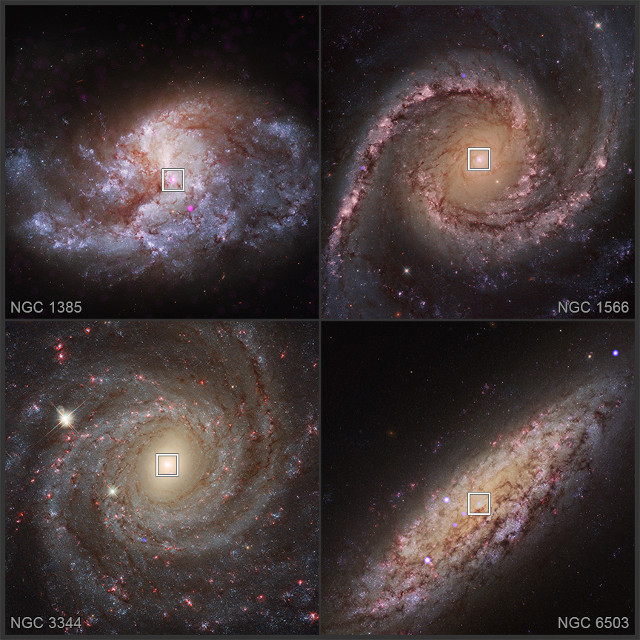
This study began by considering a sample of 207 galaxies containing nuclear star clusters. Observations conducted with the Chandra X-ray Observatory were available on in the archive for 108 of those galaxies, which became the subject of this study. The image (X-ray: NASA/CXC/Washington State Univ./V. Baldassare et al.; Optical: NASA/ESA/STScI) shows the galaxies NGC 1385, NGC 1566, NGC 3344, and NGC 6503 in a combination of X-ray observations from Chandra and optical frequencies from the Hubble Space Telescope with small squares indicating nuclear star clusters.
The Chandra X-ray Observatory has been defined as the only instrument in the world capable of finding traces of black holes in nuclear star clusters by Vivienne Baldassare of Washington State University, the lead author of this study. This claim is due to the fact that Chandra can identify the positions of the X-ray sources with the great accuracy which is important in a work of this type.
A complex analysis of the X-ray sources detected in the 108 galaxies studied made it possible to eliminate the ones generated by objects other than black holes. Eventually, in 29 of those galaxies, they found X-ray emissions with the characteristics that the researchers expect from intermediate-mass black holes. In nuclear star clusters that have a mass and density higher than a certain threshold, the traces of those black holes have a rate that is twice compared to clusters with mass and density below that threshold. In essence, this is a confirmation that mass and density help black holes grow.
This study discusses the possible growth mechanisms of black holes and offers suggestions for other attempts to identify those of intermediate-mass. The researchers will continue to examine the Chandra X-ray Observatory’s archive data to gather more information on these objects, and also to better understand how to find them, as they have been very elusive so far.
