April 2022

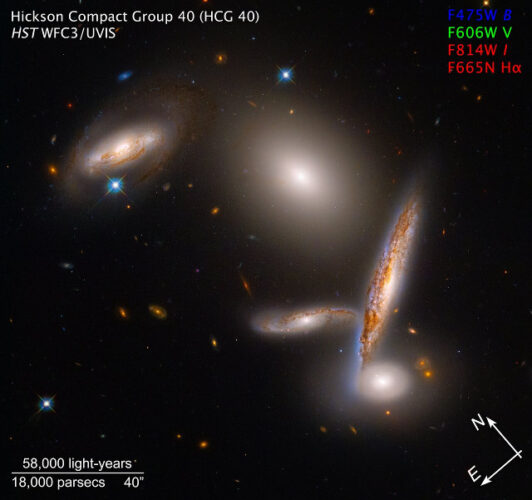
Hickson Compact Group 40 (HCG 40)

April 25, 2022, will mark the 32nd anniversary of the Hubble Space Telescope’s deployment into orbit, and to celebrate it, NASA and ESA have published images of a quintet of galaxies known as Hickson Compact Group 40 (HCG 40). This group of three spiral galaxies, one elliptical galaxy, and one lenticular galaxy is interesting for a number of reasons including the fact that within about a billion years they are predicted to collide and start merging.

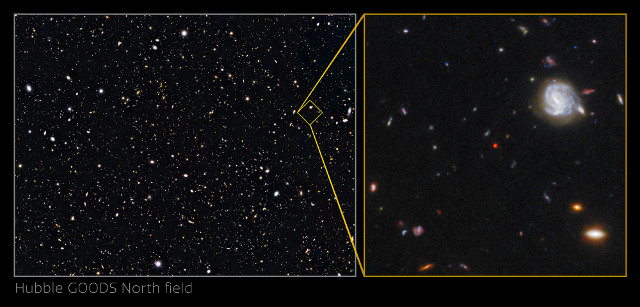
GNz7q with the likely supermassive black hole precursor in red

An article published in the journal “Nature” reports the discovery of a possible precursor of a supermassive black hole in the early universe. A team of researchers discovered the object cataloged as GNz7q in the data of the GOODS survey conducted by combining observations made with different telescopes. From Earth, we see GNz7q as it was about 750 million years after the Big Bang and its emissions can only be partially explained by a remarkable star formation. The conclusion is that there’s probably a supermassive black hole growing within the dust that fills up the primordial galaxy’s nucleus and over time it will become a quasar, a type of extremely bright active galactic nucleus.

Zhai Zhigang, Wang Yaping, and Ye Guangfu after their landing (Photo courtesy Xinhua. All rights reserved)

A few hours ago, the three Chinese taikonauts of the Shenzhou 13 mission returned to Earth after spending almost exactly six months on the Chinese space station’s Tianhe core module. Zhai Zhigang, Wang Yaping, and Ye Guangfu departed Tianhe about nine hours earlier to land at a site called Dongfeng in China’s Inner Mongolia Autonomous Region. A procedure that greatly reduces the reentry time to Earth worked perfectly. This was the first Chinese space mission to last six months, roughly twice as much as Shenzhou 12. This is the normal duration for the upcoming missions to the Chinese space station.

Artist's concept of RS Ophiuchi showing the white dwarf stealing gas from its companion (Image courtesy DESY/H.E.S.S., Science Communication Lab)

An article published in the journal “Nature Astronomy” reports a study of the recurrent nova known as RS Ophiuchi based on the detection of the gamma rays emitted by the last outburst that occurred on the white dwarf part of the pair. MAGIC Collaboration researchers examined data collected by the MAGIC telescopes and concluded that outbursts of that type generate some of the gamma rays present in the Milky Way.

Comet C/2014 UN271 (Bernardinelli-Bernstein)

An article published in “The Astrophysical Journal Letters” reports a study on comet C/2014 UN271 (Bernardinelli-Bernstein) conducted thanks to observations made with the Hubble Space Telescope. A team of researchers also used previous observations to estimate that this comet’s nucleus is about 119 kilometers in diameter. This result confirms that it’s the largest known comet. The studies will continue even if it will remain very far from Earth also because it almost certainly comes from the Oort cloud.