May 2022

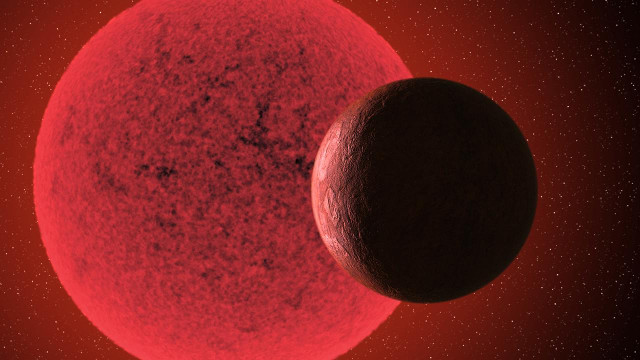
Artist's concept of a super-Earth orbiting close to a red dwarf (Image courtesy Gabriel Pérez Díaz, SMM (IAC))

An article accepted for publication in the journal “Publications of the Astronomical Society of Japan” reports the discovery of the exoplanet Ross 508 b, probably a super-Earth at the edge of ​​its star system’s habitable zone. A team of researchers led by Hiroki Harakawa used the IRD (InfraRed Doppler) instrument mounted on the Subaru Telescope to examine the star Ross 508, a red dwarf that has a mass that is only 18% of the Sun’s. The radial velocity method allowed to identify what from the collected data looks like a rocky planet with a mass that is about 4 times the Earth’s. This discovery confirms the value of infrared spectroscopic examinations of red dwarfs.

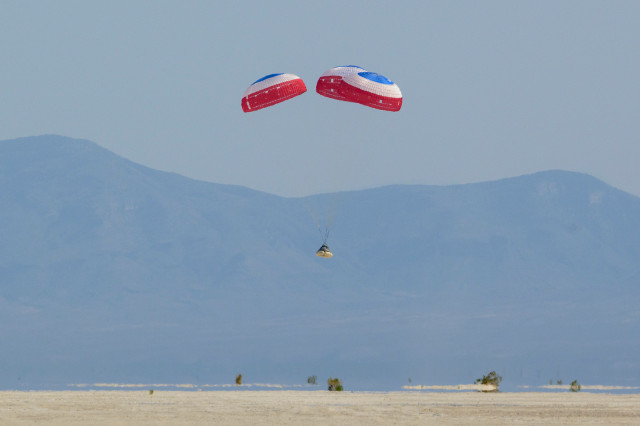
The CST-100 Starliner spacecraft landing to end its OFT 2 mission (Photo NASA/Bill Ingalls)

A few hours ago, Boeing’s CST-100 Starliner spacecraft landed at the White Sands Missile Range in New Mexico, ending its Boe-OFT 2 (Boeing Orbital Flight Test 2) mission. It departed the International Space Station, where it arrived on May 21, just over 4 hours earlier. The Starliner doesn’t splash down in the ocean but lands on the ground. The ground staff intervened in an assistance activity exercise that will take place in missions with astronauts. On board were over 250 kg of miscellaneous cargoes that need to be unloaded and the Rosie dummy.

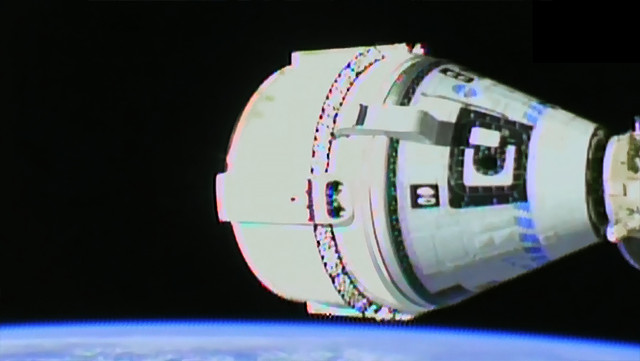
Boeing's CST-100 Starliner spacecraft docked with the International Space Station (Image NASA TV)

A few hours ago, Boeing’s CST-100 Starliner spacecraft docked with the International Space Station’s Harmony module carrying out the first part of its Boe-OFT 2 (Boeing Orbital Flight Test 2) or OFT-2 mission which began with the launch just over 24 hours earlier. The hatch is scheduled to open in the American morning and all work on the Starliner will be completed rather quickly, as it could depart already on May 25.

Boeing's CST-100 Starliner spacecraft blasting off atop a ULA Atlas V rocket in its Boe-OFT 2 mission (Photo Boeing/John Proferes)

A few hours ago, Boeing’s CST-100 Starliner spacecraft blasted off atop a ULA Atlas V rocket from Cape Canaveral on the Boe-OFT 2 (Boeing Orbital Flight Test 2) mission. After about fifteen minutes it successfully separated from the rocket’s last stage and about half an hour after launch it carried out the maneuvers to enter orbit and begin the pursuit of the International Space Station.

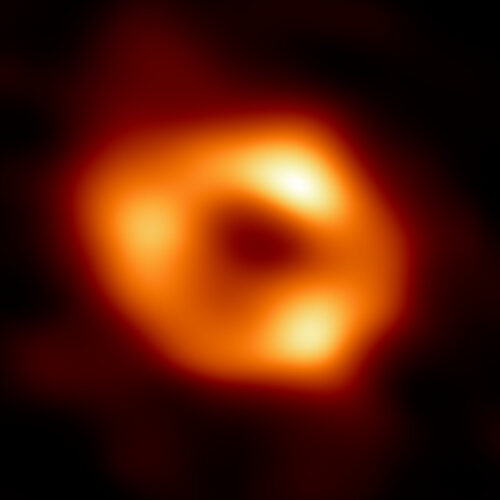
The area around Sagittarius A* (Image courtesy EHT Collaboration)

In various press conferences, representatives of the institutions collaborating in the Event Horizon Telescope (EHT) project announced that they obtained the first image of the area around Sagittarius A*, the supermassive black hole at the center of the Milky Way. The central shadow, which constitutes the black hole, is surrounded by a sort of ring formed by gas and dust that glow because they were heated by Sagittarius A*. It took the combination of 8 radio telescopes to obtain proof of the existence of this supermassive black hole, taken for granted by the vast majority of scientists but still denied by some.