
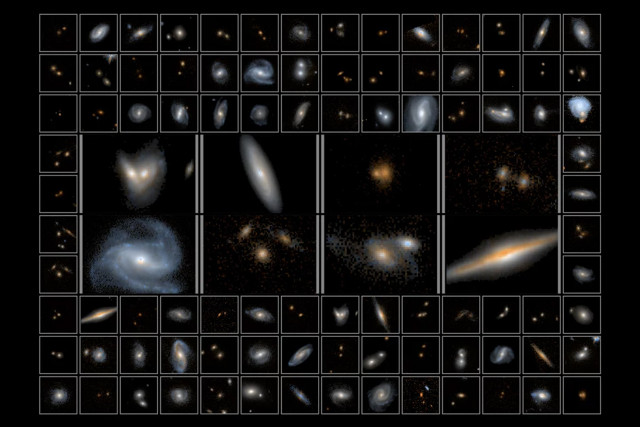
An article accepted for publication in “The Astrophysical Journal” reports the release of the results of the 3D-DASH survey, which aims to map star-forming regions to understand the formation of the most ancient galaxies, which from the Earth’s point of view are the most distant. A team of researchers used the Hubble Space Telescope to capture near-infrared images in the area known as the COSMOS (Cosmic Evolution Survey) field, a previous survey conducted with Hubble.
The formation and evolution of galaxies is one of the topics of astronomical research that made progress in recent decades thanks to increasingly powerful and sensitive instruments. However, getting details of young galaxies is difficult because the galaxies we see early in their life are very far away, over 10 billion light-years from Earth. Finding star-forming areas using ground-based telescopes is difficult because their resolution is limited, but using a space telescope is also complex. The 3D-DASH survey offers a new possibility.
The authors of the 3D-DASH investigation used the technique called DASH (Drift And SHift) to create an image eight times wider than the standard Hubble field of view by capturing multiple images during the same orbit and then assembling them together. In this way, an investigation that would have required 2,000 hours of observation was completed in 250 hours. The image (Courtesy Lamiya Mowla, all rights reserved) shows some galaxies observed in this survey.
The area covered by the 3D-DASH survey is six times the apparent size of the Moon as seen from Earth. An interactive version of the global image was created by Gabriel Brammer of the Danish University of Copenhagen and one of the authors of the article. It can be explored by anyone on the website of Lamiya Mowla of the Canadian University of Toronto, the lead author of the article.
This research offers new opportunities to map star formation areas in galaxies that have different ages to better understand both their formation and evolution. The DASH technique also represents an advance in astronomical surveys and may be adapted for other surveys.
The Hubble Space Telescope remains a valuable instrument for this type of investigation and it will take years for other instruments capable of observing large areas to be activated. The James Webb space telescope should soon begin its scientific activity but it was designed to focus on small areas, so it can be used for follow-up observations of objects considered interesting after an analysis of data collected during surveys such as 3D-DASH.
