An article accepted for publication in the journal “The Monthly Notices of the Royal Astronomical Society” reports the results of the observations of Abell 2146, composed of two galaxy clusters in their merger phase. A team of researchers led by Helen Russell of the British University of Nottingham used NASA’s Chandra X-ray Observatory to study the shock wave that formed along with the collision between the two clusters and is about 1.6 million light-years long. The processes in place show similarities with others that occur on a much smaller scale such as those generated by the solar wind.
Galaxy clusters can include hundreds of galaxies and also contain large amounts of hot gas and dark matter. The force of gravity of entire galaxies can lead to mergers, and sometimes different clusters can attract each other to the point of binding into a single structure. In these cases, only a few galaxies merge but the approach between two clusters ends up causing at least the collision of gas clouds with the consequent generation of shock waves.
Abell 2146 is a structure that is becoming a single gigantic galaxy cluster following the merger between two clusters that were separate. About 2.8 billion light-years from Earth, this cosmic clash on a massive scale is offering scientists the opportunity to study highly energetic processes. It’s a kind of physics laboratory that could not exist on Earth.
Helen Russell’s team examined Abell 2146 using the Chandra X-ray Observatory focusing specifically on the shock wave generated by the merger between the two galaxy clusters. This is a situation in which the volume of space is enormous and therefore collisions between gas particles are very rare. The consequence is that the shock wave is of the collisionless type, generated by interactions between energetic particles and magnetic fields.
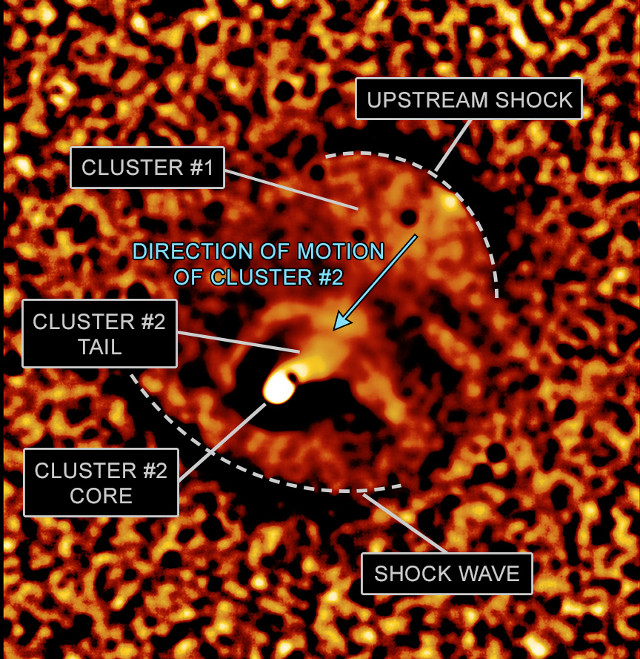
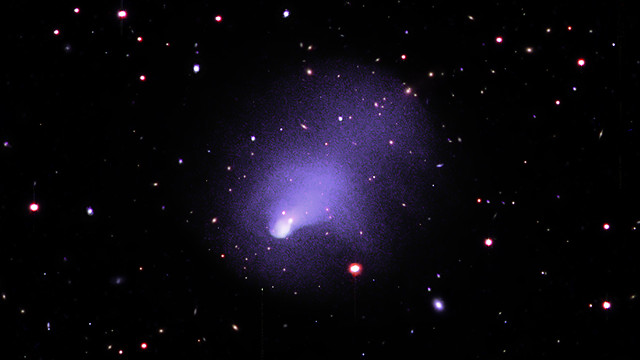
The bottom image (X-ray: NASA/CXC/Univ. of Nottingham/H. Russell et al.) shows a processing of Chandra’s X-ray data (purple) superimposed on an image at optical frequencies seen by the Subaru telescope (red and yellow). Cluster #2 is moving towards the bottom left through cluster # 1. The hot gas from cluster #2 is pushing a shock wave due to the collision with the gas from the other cluster, indicated by the dotted line. There’s also a second shock wave referred to as an upstream shock generated by an interaction of moving gas.
The observations made it possible to study the temperatures of the shock wave gas. The conclusion is that electrons were mainly heated by the compression of the gas from that shock wave, an effect similar to that seen in the solar wind. The rest of the heating took place as a result of collisions between particles in a process that, due to the diffusion of the gas, is very slow and took an estimated time of around 200 million years.
Studying these collisionless shock waves helps to better understand the processes taking place during the merger of galaxy clusters. The similarities with processes on a much smaller scale allow improving our general knowledge of these processes, which can have practical importance. For example, the solar wind represents an important influence within the solar system with ramifications that also affect the safety of satellites and astronauts.