ESA has released the third 3D map of the sky including the Milky Way and nearby galaxies obtained from the Gaia space probe, the most detailed of its kind ever produced. This catalog, built thanks to what was called Data Release 3 (DR3), greatly expands the previous maps released by ESA in recent years. Some uncertainties regarding data processing, also caused by the start of the pandemic, led ESA to publish an anticipation of DR3 called EDR3 (Early Data Release 3) on December 3, 2020.
The Gaia space probe was launched on December 19, 2013, with the aim of creating a high-precision 3D map of the stars of the Milky Way but also cataloging billions of other objects, galaxies included. Gaia started its scientific activity in July 2014, the first map included the data collected up to September 2015 while the DR2 included the following 8 months of observations.
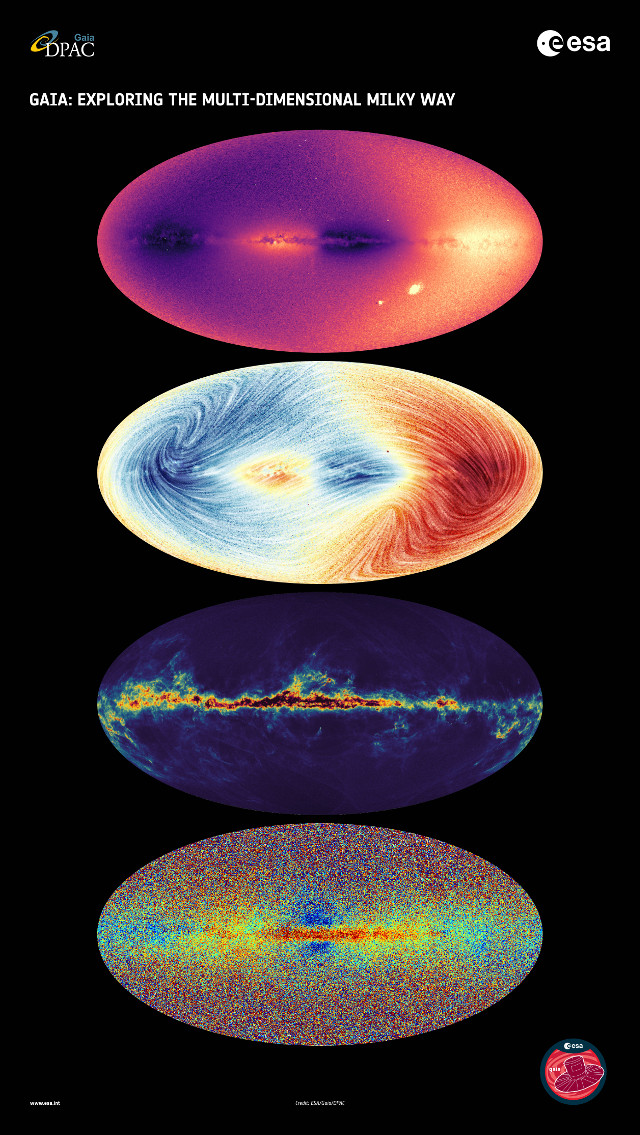
The bottom image (© ESA/Gaia/DPAC; CC BY-SA 3.0 IGO, CC BY-SA 3.0 IGO) shows four maps generated using data from Gaia’s DR3. The first map from the top is that of the radial velocity, which shows the speed at which over 30 million objects are moving toward the Earth or away from the Earth. The second map shows details of the motion of 26 million stars with the colors showing the radial velocity and the lines tracing their motion projected onto the sky. The third map shows interstellar dust in the Milky Way. The bottom map shows the distribution of the chemical elements obtained by the spectroscopic analysis of the stars.
The top infographic (© ESA) shows the various subsets of data covering a total of approximately 1,800,000,000 stars observed by the Gaia space probe. The information measured with increasing precision with each new data publication is very useful for astronomical research connected to stars but in addition to the stars, there are millions of other objects ranging from asteroids to quasars that were observed by Gaia.
A surprise came from what were called starquakes. The Gaia space probe detected small movements on the surface of thousands of stars even though it wasn’t designed for that. This is useful information to understand the processes taking place within them in the branch of astronomy called astroseismology.
The DR3 now published and available in a dedicated section of ESA’s website represents a significant step forward compared to the DR2 and also to the EDR3 but it’s not the last publication. Despite the pandemic, the work on collecting and analyzing data sent by the Gaia space probe is continuing and another publication is planned that will include all data collected in its five-year primary mission. The extended mission is expected to last until 2024 to be followed by the final catalog of results. Previous publications were already useful for many astronomical studies and certainly, the improvement in data quantity and quality will help many more future studies.