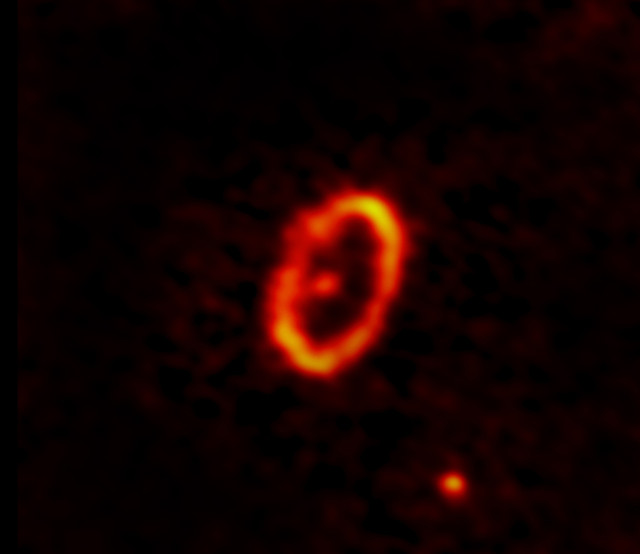
An article – link to the file in PDF format – accepted for publication in “The Astrophysical Journal Letters” reports the results of a study of the young system of HD 53143, in which a Sun-like star is surrounded by a disk of materials with a structure different from all those known so far which could include a planet. A team of researchers used the ALMA radio telescope to study that disk, which is very eccentric instead of being circular with the star in its center. The disk around HD 53143 has an elliptical shape and the star is in one of the foci of the ellipse, far from the center. The results were presented at the 240th meeting of the American Astronomical Society (AAS) held these days in Pasadena, California.
About 60 light-years from Earth, the star HD 53143 is a little smaller and less massive than the Sun but much younger with an estimated age of around one billion years. The disk of materials that surrounds it is one of the oldest known and studies are showing interesting and surprising structures.
The disk of materials around the star HD 53143 has been known for years but only now has it been possible to study it in enough detail to understand its structure. In 2006, the Hubble Space Telescope was used for the first studies but even that extraordinary instrument was unable to distinguish the various parts of the disk. One of the problems was that coronographs such as Hubble’s block the light from the star to increase the clarity of the images of nearby objects, but in this case, this meant not seeing correctly its position far from the center of the disk.
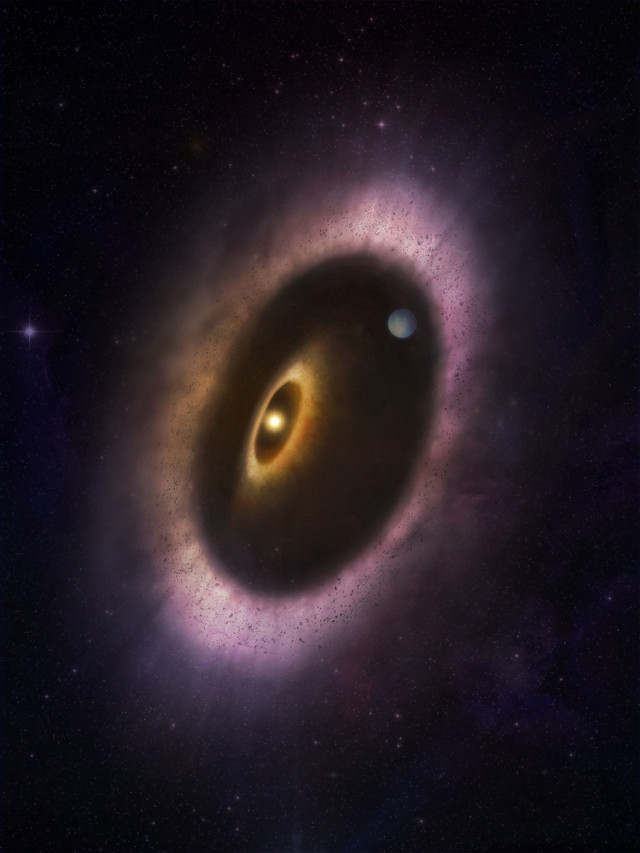
Thanks to ALMA’s highly sensitive Band 6 receivers, it was possible to observe the HD 53143 system disk without blocking the star’s light. This made it possible to recognize a complex, fragmented and elliptical structure, with the star in one of the foci of the ellipse and not in its center. There is also likely a second inner disk, near one of the foci of the ellipse, which is misaligned or tilted with respect to the outer disk. There may also be a planet already formed. The bottom image (NRAO/AUI/NSF)) is an artistic representation of that possible situation.
Some other systems with eccentric disks have been identified in the past such as that of the star Fomalhaut but that of HD 53143 is the most extreme discovered so far. The presence of a planet would explain this structure because its gravity may have influenced the disk’s shape, which was originally supposed to be almost perfectly circular. Smaller objects inside it like comets and asteroids collide and shatter into smaller debris. It’s a situation that follows the early life stages of a star system but is still evolving. For this reason, the researchers intend to continue studying it to better understand the processes taking place inside it.