
An article accepted for publication in “The Astronomical Journal” reports the results of the Gemini-LIGHTS survey on 44 young massive stars. A team of researchers used the Gemini Planet Imager (GPI) mounted on the Gemini South telescope in Chile to study the disks of materials around these stars to see if planets and ring structures have formed inside them. The results revealed the presence of possible planets and even brown dwarfs with differences between disks surrounding stars up to three times the mass of the Sun and disks surrounding more massive stars.
The Gemini Planet Imager instrument was activated in 2014 to observe exoplanets but was also used for other types of observations until 2020 when it was decommissioned. It will be upgraded and in its version 2.0, it will be improved. Version 1.0 made it possible to study protoplanetary disks obtaining high-resolution images that led to the confirmation of the existence of some objects identified as candidates in previous studies and the discovery of new candidates.
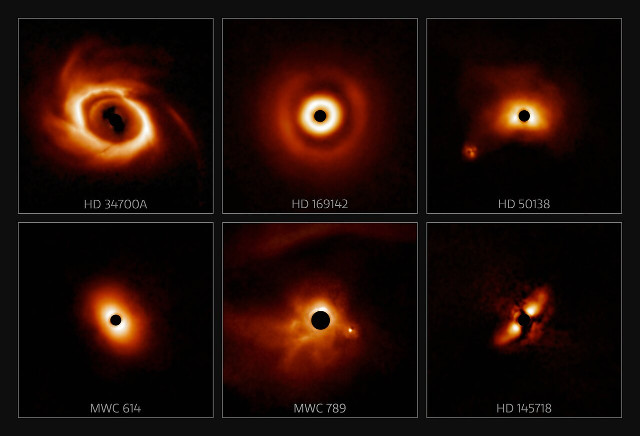
In the Gemini-LIGHTS (Gemini-Large Imaging with GPI Herbig / T-Tauri Survey) survey, the Gemini Planet Imager was used to study protoplanetary disks surrounding 80% of 44 massive stars that are a few million in age. of years. The image (International Gemini Observatory/NOIRLab/NSF/AURA/E. Rich (Michigan University)) shows an example of 6 of those systems, which are in various stages of their evolution.
Many protoplanetary disks have already been studied over the last few years but there are still questions regarding their evolution and the formation of planets. For example, rings can form inside the disks, attributed to the presence of forming planets interacting with the surrounding disk.
For this survey, 44 stars more massive than the Sun were selected to understand among other things the influence of the star’s mass on the planetary formation process. The results suggest that that process may be slightly different in disks around the most massive stars because rings tend to form around the ones with less than three times the Sun’s mass. This suggests that planets orbiting very massive stars are rare.
Among the confirmations is that of two brown dwarfs, objects halfway between planet and star, which orbit the stars V921 Sco and HD 158643. A new brown dwarf candidate was discovered around the star HD 101412 and will have to be verified in follow-up studies. An exoplanet candidate was also discovered around the star V1295 Aquilae. Its mass was estimated at 13 times the planet Jupiter’s, on the border between the planet and brown dwarf, so follow-up observations will be even more important.
The observations of the systems studied in the Gemini-LIGHTS survey bring more information regarding their formation and the early stages of their evolution. This will allow to improve the theoretical models but the studies of these and other systems will continue in the coming years to obtain comprehensive answers on the processes in place.
