
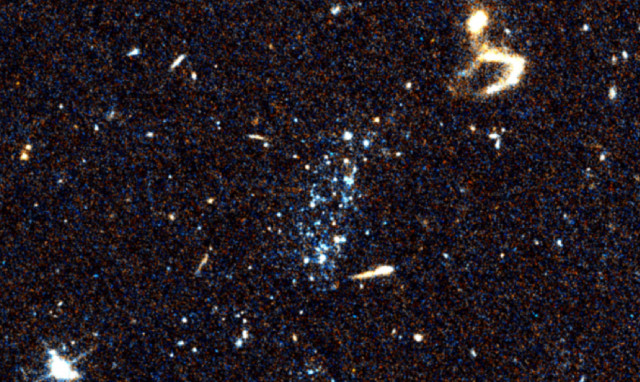
An article submitted for publication to “The Astrophysical Journal” reports the discovery of star systems that are even smaller than a dwarf galaxy and are isolated from any normal galaxy. A team of researchers examined a catalog of gas clouds found in a previous survey looking for new galaxies and found small clusters that contain mostly young blue stars scattered irregularly within the Virgo galaxy cluster. These are cases similar to the one cataloged as SECCO 1, another system discovered in the Virgo cluster and reported in an article published in February 2018 in the journal “Monthly Notices of the Royal Astronomical Society”. The discovery of other such groups may help to understand their origin.
Astronomers are used to observing star clusters within galaxies that include billions of stars each. However, the discovery of the group classified as SECCO 1, a system that is larger than a star cluster but is also smaller than a dwarf galaxy and is isolated from any galaxy, already showed that there can be unforeseen exceptions.
The systems discovered in this new study have characteristics similar to those of SECCO 1 and their distance from any galaxy, even greater than 300,000 light-years, makes it difficult to understand their origin. The gas clouds that were the original target of the study initially appeared to be associated with the Milky Way and probably are, but the star systems discovered are much farther away. SECCO 1 was already part of a separate galaxy cluster, the Virgo cluster. The newly discovered star groups appear to be part of that cluster as well.
The available data were obtained thanks to observations conducted with the Hubble Space Telescope, the Very Large Array in New Mexico, and the Very Large Telescope in Chile. These telescopes made it possible to discover that the groups appear as blue blobs because they’re formed mainly by young massive stars, which are blue in color. Spectroscopic analyzes indicate that in most of those groups there’s no atomic hydrogen but there may still be hydrogen in the form of molecules, which makes sense considering that stars are still forming within them.
The combination of the presence of massive young stars, a lack of old low-mass stars, and a shortage of atomic hydrogen is another surprise. Michael Jones of the University of Arizona, the lead author of the study, explained that he and his colleagues expected to find old low-mass stars, which are red in color, because they have very long lifetimes and therefore are the last to die. He compared the groups discovered to desert oases.
The researchers tried to offer some hypotheses about the origin of these unusual stellar groups. The considerable distance from the nearest galaxies makes it unlikely that they were stripped from one of them by the gravitational effect caused by a neighbor passing nearby. A more likely possibility is that gas clouds have been stripped from galaxies by the so-called ram pressure, the pressure exerted on them as they pass through the intergalactic medium, mainly hot gas that is also present between galaxies in a cluster.
According to the researchers, this type of mechanism could also affect the shape of galaxies by turning many spiral galaxies into elliptical galaxies. The ejected systems could fragment over time into individual star clusters that will scatter within the galaxy cluster. These are processes that take place over millions of years, so astronomers must hope to find others where this is already happening to verify this hypothesis.
