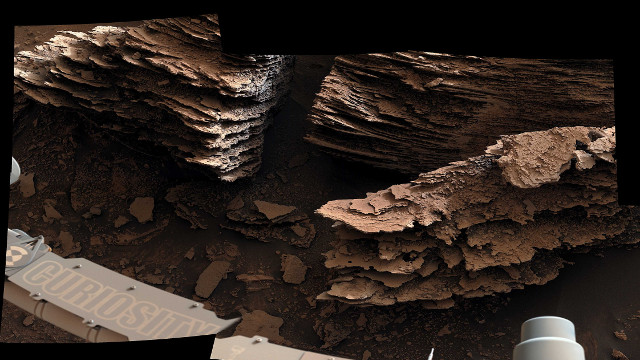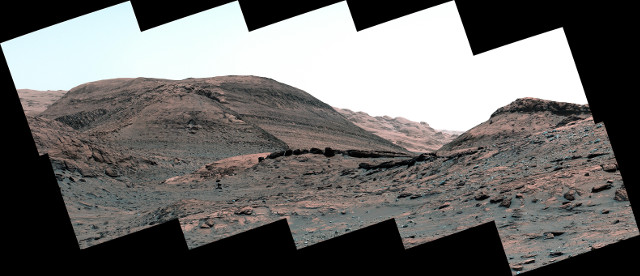
NASA has released the results of data analysis recently collected by its Mars Rover Curiosity during its ascent of Mount Sharp on Mars. After spending years in areas of Gale Crater that surround the zone where there were still many traces of the ancient presence of water, Curiosity started traveling in a transition zone from a clay-rich region to one full of sulfate salt. The interest in that area is given by the fact that it shows the traces of the great climatic changes that transformed a planet that, when it was young, was similar to the Earth into today’s red planet.
The Mars Rover Curiosity has been climbing Mount Sharp since 2014 and examining clay rocks and other traces of water over an extended period when Mars was young helped a lot in reconstructing the planet’s history. Gale Crater was a lake that perhaps existed for millions of years whose traces still exist but Curiosity has reached an altitude on Mount Sharp where the evidence points to a drier climate. There was still water but these were streams and ponds around sand dunes.
The sulfate that Curiosity discovered instead of the clay present at lower altitudes shows a noticeable change in that transition area. The hills of that area probably formed in a dry environment of dunes that formed rocks over time. The sediments generated by the small streams of water that remained still exist between the geological layers which are like records of the climatic changes that occurred over time. In the top image, the mount visible in the center forms a part of the sulfate-containing area.
The work of the Mars Rover Curiosity has been difficult recently because on June 7, it entered the so-called safe mode after part of the instrumentation turned out to be hotter than expected. In such cases, a vehicle, be it a rover or a space probe, shuts down all non-essential functions for safety reasons. NASA’s JPL engineers restored Curiosity’s full functionality after two days but are still analyzing the data to figure out the causes of the problem, which may just be in one of the heat sensors.
Despite these problems and the damage accumulated in its wheels, the Mars Rover Curiosity is nearing 10 Earth years of work on Mars. Its long journey continues to offer new insights into the geological and climatic history of Mars. Curiosity is scheduled to carry out further drilling to provide more details on the mineral composition of the rocks and add another piece to the puzzle of the changes that transformed Mars into the red planet we know today.