
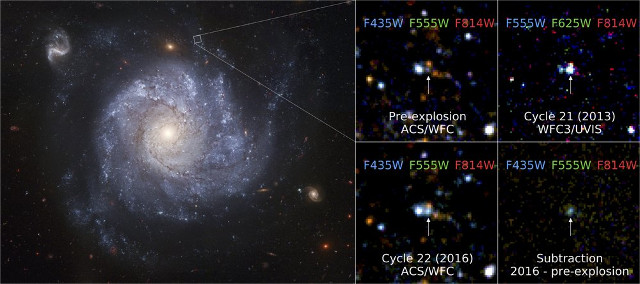
An article published in “The Astrophysical Journal” reports a study of the consequences of the supernova cataloged as SN 2012Z, considered to be of the type Iax, which means that it’s the explosion of a white dwarf. A team of researchers used the Hubble Space Telescope to study its remnants and found that the star survived the supernova and is even brighter than before. One possibility is that the explosion was too weak to scatter the remnants of the white dwarf into interstellar space with the result that they started re-aggregating.
Type Ia supernovae have been studied for years and what seemed like a simple mystery to solve is turning out to be more and more intricate. According to the accepted model, a white dwarf that steals gas from a companion can reach a critical mass that causes its explosion. The discovery of supernovae of this type that don’t completely destroy the white dwarfs led to new investigations into the possibility that there are less powerful explosions than type Ia supernovae. The new proposed classification is the type Iax and the supernova SN 2012Z is a case that turned out to be very interesting.
The supernova SN 2012Z was identified in January 2012 in the spiral galaxy NGC 1309, about 110 million light-years from Earth. After its discovery, the examination of images in the Hubble Space Telescope’s archive between 2005 and 2006 made it possible to identify this supernova’s progenitor star, the first time this happened when the progenitor was a red dwarf. These findings were published in August 2014 in an article in the journal “Nature”. The studies continued and part of that team also produced the article now published in “The Astrophysical Journal”.
The image (Courtesy McCully et al) shows on the left the galaxy NGC 1309 and on the right images of the area where the supernova SN 2012Z occurred, captured over the years. The comparison shows that the star’s brightness even increased after the supernova. It came as a surprise because astronomers expected the white dwarf to have been destroyed or that only a so-called zombie star remained, a part of the original white dwarf that survived.
Several cases of zombie stars have already been discovered, such as the one in the supernova remnants cataloged as LP 40-365. It was described in an article published in the journal “Science” in August 2017. The characteristics of the supernova SN 2012Z indicated that it was of the Iax type and therefore a zombie star may have remained but an increase in brightness is an unexpected result.
According to the researchers, it’s possible that the white dwarf progenitor of the supernova SN 2012Z was destroyed but that the explosion was not powerful enough to scatter the remnants into interstellar space. In such a case, the consequence is that the force of gravity prevails and causes the remnants of the white dwarf to slowly re-aggregate. The new white dwarf could be, at least temporarily, larger than its progenitor and that would explain the greater brightness.
Type Iax supernovae are kept under observation by astronomers to improve models that describe the processes leading to the explosion and their consequences. For this reason, this is not the last study ofSN 2012Z, also because the visibility in its area should keep on improving as debris is captured by the surviving star or disperses into interstellar space.
