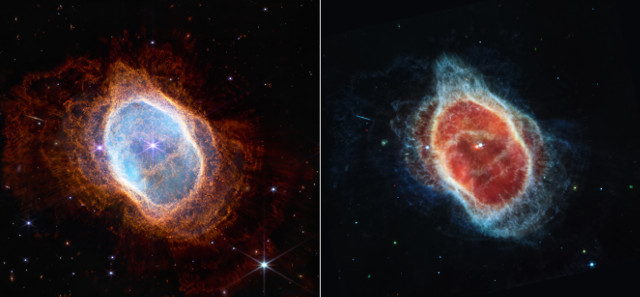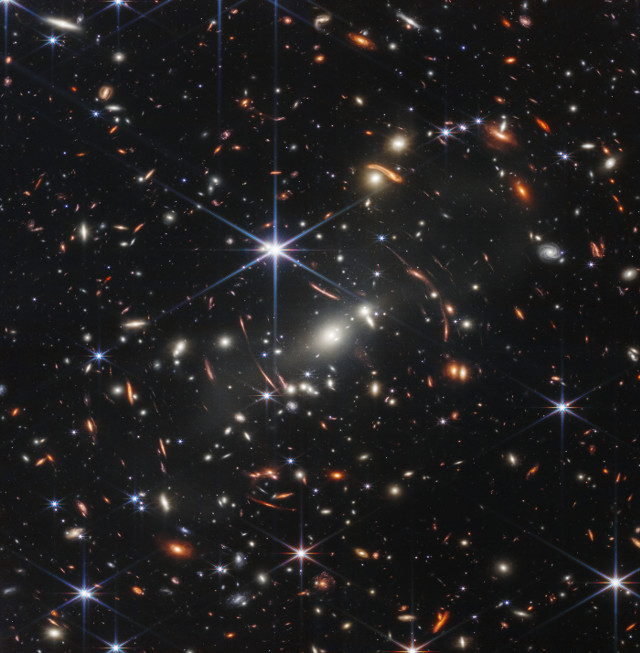
NASA has released the first official images captured by the James Webb Space Telescope. The presentation was made in collaboration with ESA and CSA (Canadian Space Agency), the other space agencies that work together with NASA on the project and its management. Yesterday, when it was afternoon at the White House, US President Joe Biden personally presented the top image, Webb’s First Deep Field image that includes the SMACS 0723 galaxy cluster as a preview, a proof of the importance of this space telescope.
Launched on December 25, 2021, the James Webb Space Telescope finally begins its scientific activity after long years of design and construction. Due to its complexity, the instrument calibration took months, an operation that began during the journey to the area about 1.5 million kilometers from Earth where it will conduct its observations. So many things could go wrong in a mission made very complex by the need to unfold the various parts of Webb that were folded up at launch in order to fit onto the top of the Ariane 5 rocket.
For this presentation of the first official results, NASA chose five observation targets: the Carina Nebula, the exoplanet WASP-96b, the Southern Ring Nebula, the group of galaxies known as Stephan’s Quintet, and the SMACS 0723 galaxy cluster. These are very different targets that can provide a broad idea of the possibilities that Webb will offer in the coming years of astronomical research regarding color images and spectroscopic examinations.
Various images captured during the test phase of the James Webb Space Telescope were already published in the past few weeks and already showed extraordinary results. The expectations were huge, also considering the years of waiting for Webb and its enormous costs, but the results seem even better.
US President Joe Biden together with Vice President Kamala Harris presented a preview with what was called Webb’s First Deep Field image that shows many galaxies, some of them very ancient, and in the foreground, the SMACS 0723 cluster, about 4.6 billion light-years from Earth. It’s only a tiny area of the sky, comparable to the size of a grain of sand held by a person at arm’s length. It contains the faintest objects ever observed at infrareds, as some of them are undetectable by the Hubble Space Telescope. That was achieved by Webb in 12.5 hours versus the weeks it took Hubble to obtain a deep field image.
The image presented by President Joe Biden and the images published by NASA are just a taste of what is to come. Uncovering the secrets of the cosmos is a crucial goal but there’s a lot to study in the universe, from exoplanets that potentially host life forms to processes connected to black holes. The James Webb Space Telescope will make it possible to make progress, sometimes unexpected, in these studies.