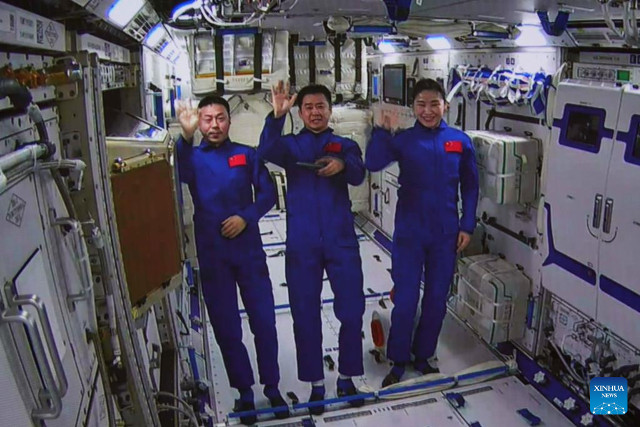
A confirmation has arrived that the Wentian module has successfully completed its docking maneuvers with the Chinese Tiangong space station’s Tianhe core module. Wentian was launched about 13 hours earlier from the Wenchang base atop a Long March-5B Y3 rocket. A few hours after docking, the taikonauts, as the Chinese call their astronauts, of the Shenzhou-14 mission entered the new module. This is another crucial step in the construction of the Chinese space station.
Almost 18 meters long and with a mass of around 23,000 kilograms, the Wentian module is the first laboratory launched to assemble the Chinese Tiangong space station. It includes various backup functions that offer redundancy to those of the Tianhe core module with avionics, propulsion, and an airlock to allow the taikonauts to have a second exit and entry to the station when they have to perform extravehicular activities.
One of the tools of the Wentian module is a robotic arm that can be used to manipulate various payloads, for example, to place an instrument or an experiment outside the station. It can also be used as an extension of the robotic arm on the Tianhe core module.
The Wentian module is primarily a laboratory in which the taikonauts will be able to conduct experiments. The Chinese authorities offer little information on scientific and technological research activities conducted in space but it has been revealed that they will cover several different fields.
This is the first expansion of the Chinese space station after the Tianhe core module was launched into orbit in April 2021. The Wentian space laboratory arrived when the taikonauts of the Shenzhou-14 mission were on board: they entered it and will already start testing the correct functioning of the onboard systems.
The successful arrival of the Wentian module means that China can proceed with the launch of the second space laboratory, called Mengtian, which will also be connected to the Tianhe core module. Its launch is scheduled for October 2022. The expansion of the station will also allow increasing the crew on board from 3 to 6 people. The Chinese authorities offer limited information on the operations connected to their space program but it’s clear that plans regarding their space station are progressing with a presence that’s becoming continuous of personnel in orbit.