July 2022

The Dragon 2 cargo sapcecraft blasting off atop a Falcon 9 rocket to start its CRS-25 mission (Photo NASA)

A few hours ago, the SpaceX Dragon 2 spacecraft blasted off atop a Falcon 9 rocket from the Kennedy Space Center in its CRS-25 (Cargo Resupply Service 25) mission, also referred to as SPX-25. After almost exactly 12 minutes it separated successfully from the rocket’s last stage and went en route. This is the 25th mission for the Dragon/Dragon 2 spacecraft to resupply the International Space Station with various cargoes and then return to Earth, again with various cargoes.

The Vega-C rocket blasting off for its maiden mission (Image courtesy ESA)

A little while ago, the new European Vega-C rocket, the evolution of the Vega rocket that was in service for almost exactly 10 years, blasted off from the European launch base in French Guayana. After about 85 minutes, various satellites started being put into orbit including LARES-2 for the Italian Space Agency and some nanosatellites.

The main payload for the first flight of the Vega-C carrier rocket, referred to as VV21, is the LARES-2 (Laser Relativity Satellite 2) satellite of ASI (Italian Space Agency). It’s an improved successor to the LARES satellite launched on February 13, 2012, during the original Vega rocket’s qualification flight. The aim remains to test some aspects of the theory of relativity.

The secondary payload consists of CubeSat-class nanosatellites, which are now very common and consequently normal cargoes for a launch vehicle like Vega-C. These are the Italian AstroBio CubeSat and Greencube, the Slovenian Trisat-R, and the French MTCube-2 and Celesta.

Webb's First Deep Field (Image NASA, ESA, CSA, and STScI)

NASA has released the first official images captured by the James Webb Space Telescope. The presentation was made in collaboration with ESA and CSA (Canadian Space Agency), the other space agencies that work together with NASA on the project and its management. Yesterday, when it was afternoon at the White House, US President Joe Biden personally presented the top image, Webb’s First Deep Field image that includes the SMACS 0723 galaxy cluster as a preview, a proof of the importance of this space telescope.

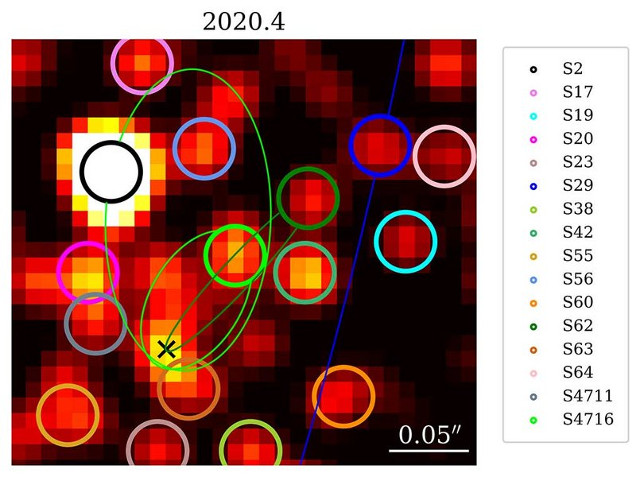
16 stars of the S cluster

An article published in “The Astrophysical Journal” reports the identification of the star with the closest orbit around Sagittarius A*, the supermassive black hole at the center of the Milky Way. A team of researchers cataloged it as S4716 after finding it in data collected over twenty years with the Keck Observatory, the VLT, and the VLTI. The star S4716 completes an orbit in about 4 Earth years and its distance from Sagittarius A* is as close as 100 times the Earth’s from the Sun. Its discovery, which breaks the record of the star S4711, is surprising and will help to better understand how stars in that area formed and moved, as it’s difficult to think that it formed this close to a supermassive black hole.