August 2022

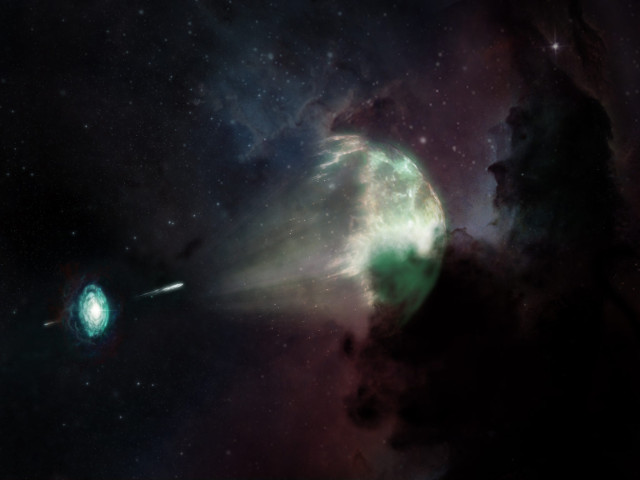
Artist's concept of the events that generated the short gamma-ray burst GRB 211106A (Image ALMA (ESO/NAOJ/NRAO), M. Weiss (NRAO/AUI/NSF))

An article accepted for publication in “The Astrophysical Journal Letters” reports the results of the analysis of the detections of the short gamma-ray burst cataloged as GRB 211106A conducted thanks to the ALMA radio telescope. A team of researchers examined the afterglow generated by the interaction with the surrounding gas of the jets that accompany the gamma-ray burst and move at a speed close to the speed of light. This is the first case in which ALMA has been used to examine such an event and other observations were conducted with the VLA and various space telescopes. The resulting dataset covers the various electromagnetic bands and allowed the researchers to conclude that this gamma-ray burst was generated by the merger of two neutron stars.

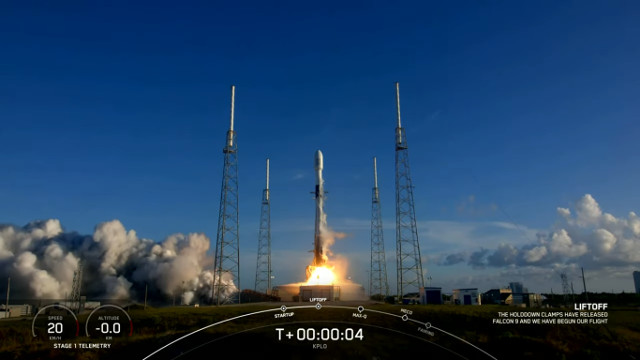
The Danuri space probe blasting off atop a Falcon 9 rocket (Image courtesy SpaceX)

A few hours ago the Korea Pathfinder Lunar Orbiter (KPLO) space probe, which recently received the official name Danuri, blasted off atop a SpaceX Falcon 9 rocket from Cape Canaveral. After just over 40 minutes, it successfully separated from the rocket’s last stage and began the series of maneuvers that will take it into the Moon’s orbit. It’s a long journey planned using what is technically called Ballistic Lunar Transfer (BLT) to optimize efficiency and save the onboard fuel. This means that it will enter the Moon’s orbit only on December 16. If everything works well, Danuri will begin its one-year scientific mission in which its instruments will conduct various surveys.

The Cartwheel galaxy seen by the James Webb Space Telescope (Image NASA, ESA, CSA, STScI)

An image captured by the James Webb Space Telescope shows the Cartwheel galaxy in greater detail than those obtained in the past with other telescopes. A combination of Webb’s NIRCam and MIR instruments allowed the identification of individual stars and star-forming regions while also offering new insights into the behavior of the supermassive black hole within this peculiar galaxy. This is a new help in the study of the changes taking place in what is most likely the consequence of a collision between two different galaxies with a transformation still taking place.

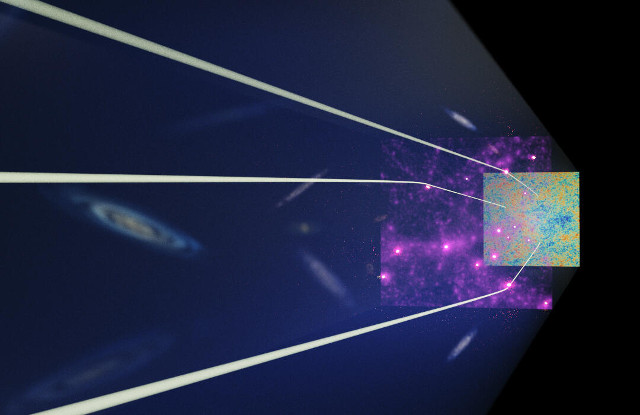
An artistic representation of the combination of the observations obtained in the HSC-SSP survey and the cosmic microwave background data collected by the Planck Surveyor space probe

An article published in the journal “Physical Review Letters” reports the results of an analysis of dark matter distribution around 1.5 million primordial galaxies. A team of researchers led by Hironao Miyatake of the Japanese University of Nagoya used observations conducted with the Subaru telescope and analyzed data collected by the Planck Surveyor space probe to detect distortion of the cosmic microwave background (CMB).

The results of this study show fluctuations in dark matter distribution in the early universe that led to inhomogeneity in the aggregation of ordinary matter that formed galaxies. That aggregation is lower than predicted by the Lambda-CDM model, the one that currently best describes the observations. The uncertainty lies in the difficulty of obtaining precise results in examining very distant galaxies.