
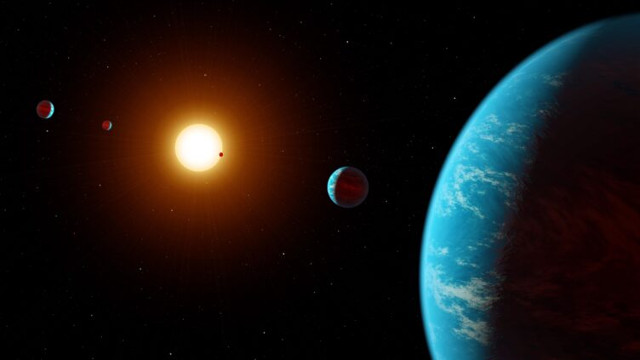
An article published in the journal “Astronomy & Astrophysics” reports the confirmation of the presence of 5 rocky planets in the HD 23472 star system. A team of researchers used the Espresso spectrograph on ESO’s VLT to examine these exoplanets to estimate their masses using the radial velocity method. Their sizes were already known thanks to the data collected by NASA’s TESS space telescope, which observed their transit in front of their star. The result of the examination is that three of those exoplanets are super-Earths and two are probably super-Mercuries, rare cases characterized by a larger iron core and in general a high percentage of iron.
Launched on April 18, 2018, the TESS Space Telescope started finding exoplanet candidates right from the start of its scientific mission. In the case of HD 23472, a star with a mass and radius about three-quarters of the Sun’s about 127 light-years from Earth, the observations conducted over time made it possible to identify five candidates. They were subsequently verified but the problem was to establish their nature.
The verification of the first two exoplanet candidates was also published in the journal “Astronomy & Astrophysics” in January 2019. However, the authors of that study hypothesized that they were Neptunian or sub-Neptunian exoplanets based on archival data collected by the HARPS spectrograph mounted on ESO’s 3.6-meter telescope at the La Silla Observatory in Chile. The researchers themselves indicated that further measurements using the radial velocity method would be useful.
Now, new data was published which is based on measurements made with the Express spectrograph at the Paranal Observatory, in Chile, more perfected than HARPS. The new data covers all five planets of the HD 23472 system now confirmed with interesting results. The estimate of the masses combined with the measure of the sizes already known thanks to the transits of the exoplanets in front of their star allowed to estimate their density as well leading to the conclusion that they are five rocky planets. Two of these exoplanets turned out to be far denser, just like Mercury, a very interesting discovery because they’re rare planets.
Mercury has a density similar to that of Earth but is much smaller. The Earth’s density is due to its composition but also to its mass, which generates considerable gravitational compression. Mercury’s density is much more due to its composition and its iron core is estimated to make up nearly half of the planet while the Earth’s iron core makes up less than a fifth of its mass.
According to one of the theories on Mercury’s formation, the planet was originally more massive with a composition similar to the Earth’s but the impact of a planetesimal dispersed its outer layers into space. According to another theory, the proximity of the Sun caused the evaporation of the lighter elements to the point of depriving it of the mantle. Another possibility is that conditions within the protoplanetary disk from which the solar system formed led to the formation of a planet with Mercury’s characteristics.
Among the thousands of exoplanets discovered, very few are similar to Mercury, so it’s difficult to make comparisons, and finding two candidates for that type of planet in the HD 23472 system is a stroke of luck. The researchers warn that more precision is needed in estimating their masses to be sure they really have the high density of that type of planet. That’s important in order to make some evaluations on the mechanisms of their formation. An impact that could leave a planet without a mantle is rare, two in the same system are very unlikely.
The outermost planet among those discovered in the HD 23472 system has a year that lasts less than 30 Earth days, so these planets are too hot to host Earth-like life forms. However, this system offers reasons of scientific interest, so it will continue to be studied.
