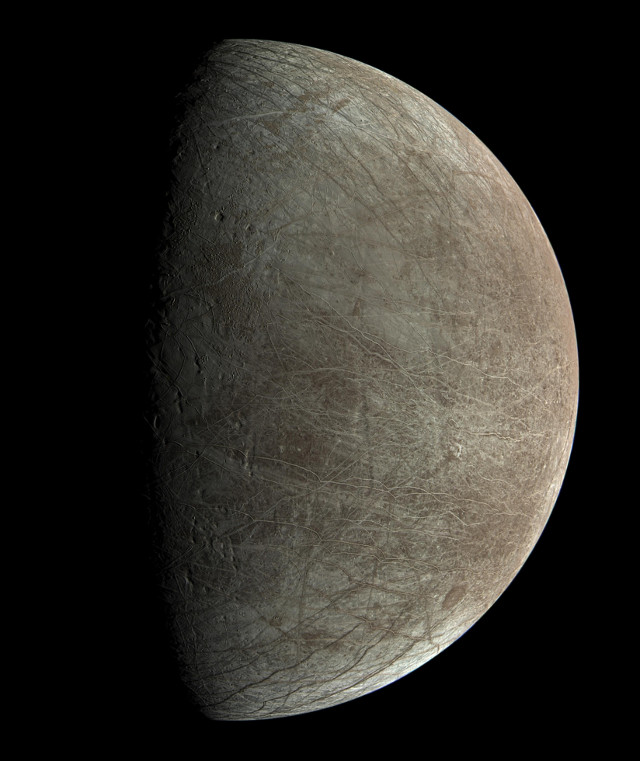
NASA has released images of Europa, one of Jupiter’s so-called Galilean satellites, captured by its Juno space probe during a flyby conducted on September 29. The JunoCam was the main instrument for this task but for the occasion, a close-up shot was also captured by the SRU (Stellar Reference Unit), an instrument generally used to orient Juno by observing the stars. The photos taken by JunoCam were processed by some of the so-called citizen scientists, amateurs who contribute following their personal passion.
In Jupiter’s orbit since July 4, 2016, the Juno space probe is primarily used to study the largest of the planets in the solar system. However, sometimes its trajectory can be efficiently changed to bring it close to one of the moons.
Europa has been the subject of great interest for many years due to the presence of an underground ocean of liquid water in which conditions exist that could be favorable to the development of life forms. On September 29, there was an opportunity for the Juno space probe to get close to Europa and capture some images that could be useful in the study of this moon.
The images of the NASA missions have been available for some time already in unprocessed versions but subsequently the agency also publishes processed versions, useful for scientists to see the details of the object of their studies. There are professionals who process images by working on colors and contrasts in order to bring out the details but there are also fans who do that work in their spare time. Their contributions are recognized by NASA, which often publishes images processed by these fans.
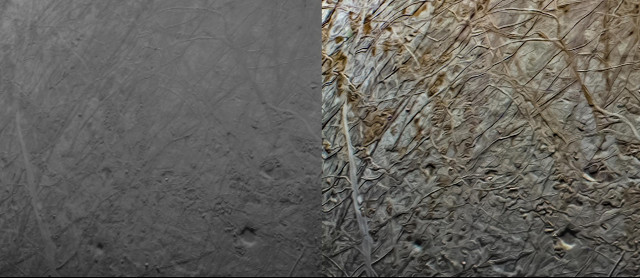
The image below (NASA/JPL-Caltech/SwRI/MSSS image processing by Navaneeth Krishnan S) shows a portion of the surface of Europa in a photo taken by the JunoCam on September 29 in the version with minimal processing on the left and in the enhanced version on the right.
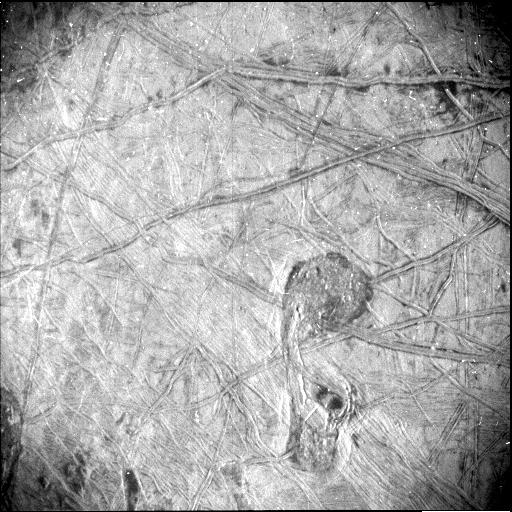
The fractures on Europa’s icy surface tell its story, marked by the stress to which this moon is subjected due to the gravitational interaction with Jupiter. There are also other geological formations including some elliptical in shape whose origin is still under discussion. For this reason, the photos captured by the SRU, which for once was not used to orient the Juno space probe, are also useful.
The bottom photo (NASA/JPL-Caltech/SwRI) shows an area of Europa’s surface of approximately 150 by 200 kilometers. Some spots could be linked to underground eruptions but the question remains open. The SRU instrument is designed to work in low-light conditions and proved useful for scientific purposes by capturing details such as lightning in Jupiter’s atmosphere or, as in this case, on Europa’s surface.
NASA is setting up the Europa Clipper mission, which is scheduled to start in 2024 and reach the Jovian system in 2030, precisely to study this moon in depth. So far, telescopes and space probes have collected information that offers clues to Europa’s underground ocean but a dedicated mission is needed to try to understand if it hosts life forms.