
In a press conference, NASA confirmed the success of its DART mission after ascertaining that the orbit of asteroid Dimorphos was changed by the impact of the spacecraft. According to calculations, Dimorphos now orbits the asteroid Didymos in 11 hours and 23 minutes while before the impact, it took 11 hours and 55 minutes for each orbit. The margin of error is approximately 2 minutes, which indicates that the success is far greater than the minimum predicted. The monitoring will continue, especially by the LICIACube mini-probe, to obtain more precise data, also on the materials ejected after the impact, as their characteristics will help to understand the composition of Dimorphos.
The test conducted when it was September 26 at NASA mission control was the first with the aim of deflecting an asteroid through an impact with sufficient mass and speed to influence the trajectory of an object dangerous for the Earth. NASA expected to change Dimorphos’ orbit by at least 73 seconds but the estimate was very vague because this asteroid’s composition is unknown.
Observations conducted after the impact of the Double Asteroid Redirection Test (DART) space probe indicate that the asteroid Dimorphos’ orbital period was reduced by about 32 minutes, a result considered excellent. According to the reconstruction, the materials ejected following the impact generated an action-reaction effect, a sort of recoil that increased the effect sought.
Trying to understand the characteristics of the ejected materials is important to improve the models used to calculate the effects of this type of operation. This includes possible information about the characteristics of the Dimorphos’ surface, from which those materials come.
The LICIACube mini-probe, a CubeSat-class nanosatellite designed by the Italian Space Agency, remains in the area of the two asteroids to closely monitor the situation. The images sent by the DART space probe provided the first details on the shape of the two asteroids and LICIACube provided and will continue to provide more of them, useful to obtain even more precise estimates of Dimorphos’ mass.
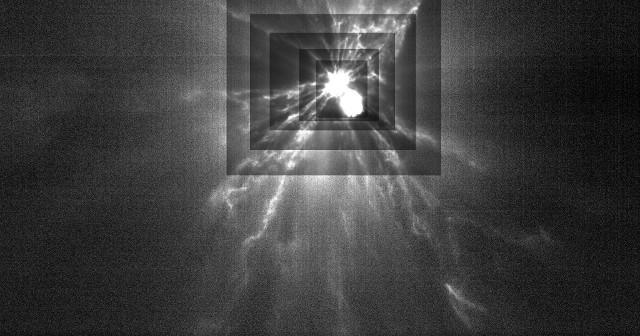
The image shows Dimorphos and the materials ejected following the impact of the DART space probe as seen by the LICIACube mini-probe. Each rectangle represents a different level of contrast used to better see the structures of those materials.
The long-term consequences of the DART mission will also be examined by ESA’s Hera space probe, which is scheduled to launch no earlier than October 2024 to reach Didymos and Dimorphos at the end of 2026. It’s another project that is part of the program to defend Earth from dangerous asteroids. Dimorphos never posed any danger, and any different information that appeared in news regarding the DART mission is incorrect. However, sooner or later, dangers will come from space and it will be much better for humanity if there’s a defense.
