
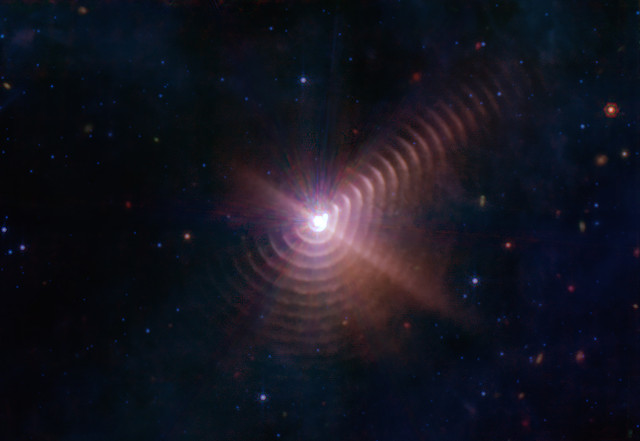
An article published in the journal “Nature Astronomy” reports the observation of 17 dust rings around WR 140, a so-called Wolf-Rayet star that has a very young and massive companion. A team of researchers used the James Webb Space Telescope’s MIRI instrument to study the area around this pair of stars, obtaining results far superior to those of other instruments, which had only identified two rings. According to the researchers, the rings are generated when the two stars get closer and their stellar winds interact violently causing the gas to compress, as it also contains elements heavier than hydrogen and allows it to form dust.
The Early Release Science program selected the first observation targets for the James Webb Space Telescope, launched on December 25, 2021. More than 5,000 light-years away from Earth, WR 140 and its companion are interesting because Wolf-Rayet stars, which go through quick and violent transformations ejecting enormous quantities of materials, are rare due to their short life, and this pair was already known to be surrounded by two rings of dust.
According to the reconstructions carried out in previous studies, the dust rings are formed when the two stars are at their minimum distance. They orbit each other in an elongated orbit, so the conditions around them can vary considerably as their distance varies. When the distance is at a minimum, their stellar winds collide violently generating a strong compression effect. Stellar winds mostly contain hydrogen but Wolf-Rayet stars also eject heavier materials such as carbon, so compression can form dust.
The two stars orbit each other in almost 8 Earth years but knowing only two rings of dust that surround them left various doubts. The James Webb Space Telescope made it possible to achieve great progress in studying the area around WR 140 and its companion by observing 17 rings. The outermost ring is now more than 70,000 times the distance of the Earth from the Sun away from the pair of stars.
The ring system around the two stars was compared to tree rings because they allow studying the timeline of stellar life. If each ring corresponds to 8 years, 17 rings correspond to over a century. There may still be more outer rings but they’re probably so scattered in such dim light that even Webb can’t spot them.
Other Wolf-Rayet stars are known to produce dust but this is the only case where dust rings have been observed. The pair of stars in an elongated orbit isn’t the only curiosity because the rings are also well-defined. According to the researchers, stellar winds blow away residual debris in the surrounding space.
The James Webb Space Telescope’s MIRI instrument also allows conducting spectroscopic analysis in the mode called MRS (Medium-Resolution Spectroscopy). This made it possible to detect chemical signatures consistent with the presence of polycyclic aromatic hydrocarbons (PAFs), which play an important role in the formation of stars and planets and even in reactions that are important in the birth of life forms. There are various theories about their origin and this study shows that pairs of stars like the one at the center of this study can form these compounds.
Wolf-Rayet stars are also considered important in the formation of new stars and planets due to the effect of their powerful stellar winds. They sweet away large amounts of materials compressing them in interstellar space until they become dense enough to trigger the formation of new stars.
The James Webb Space Telescope is delivering great astronomical results very quickly. In this case, it offered a much greater amount of detail about the area around a pair of stars than other instruments, providing a lot of new information useful for better understanding a range of stellar processes.
