
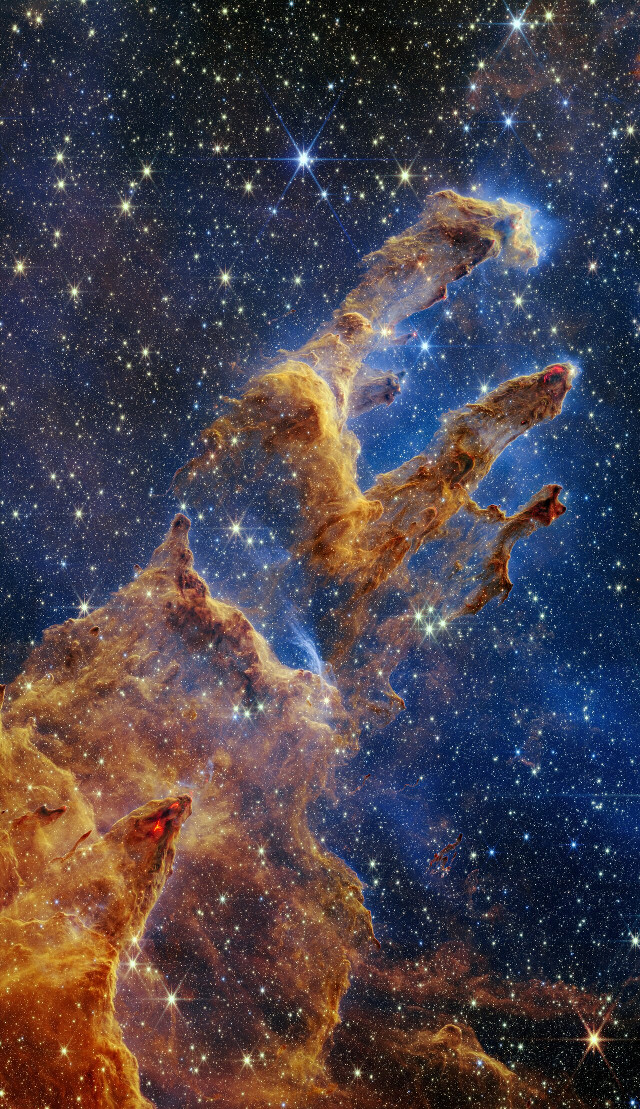
The so-called Pillars of Creation have been portrayed in some of the iconic images captured by the Hubble Space Telescope. Now the James Webb Space Telescope obtained even more detailed views of that star-forming area that is part of the Eagle Nebula. Webb’s infrared sensitivity can see even inside dust clouds where there are newborn stars and areas where stars are forming. That hasn’t only made it possible to obtain even more spectacular photos but also to provide a lot of new information useful to improve the models concerning star formation.
The columns of dark gas associated with the birth of stars within the vast Eagle Nebula led to the nickname Pillars of Creation. They became famous beyond the field of astronomy in 1995 when the first photos captured by the Hubble Space Telescope were published.
The Pillars of Creation’s fame grew further since the end of 2014 with the image captured following the installation of Wide Field Camera 3. This instrument replaced the previous one, allowing for higher-resolution images with a wider field of view. This made it possible for Hubble to obtain an even more extraordinary image that was raised to the level of an astronomical icon.
A huge problem in the study of star-forming areas is caused by the fact that the concentration of gas and dust necessary to obtain the birth of stars blocks many electromagnetic frequencies. Infrareds are among the few that pass through those clouds, which is why the instruments that can detect them are very valuable.
Launched on December 25, 2021, the James Webb Space Telescope was designed to achieve infrared detections far superior to all other existing instruments. We can see the results, in this case, with many new details on the Pillars of Creation. The Near-Infrared Camera (NIRCam) is the Webb instrument that made it possible to achieve this terrific result.
Very interesting formations are visible in red in some of the pillars, especially in the area of their “tips”. The spherical ones are concentrations of gas and dust that are heating up due to the effect of gravity that is causing the collapse that will lead to the birth of new stars. Some formations have shapes that resemble lava flows and are jets emitted at supersonic speed by protostars.
The result obtained is truly extraordinary and yet the interstellar medium, also formed by gas and dust in the densest part of the Milky Way, hides the galaxies behind it even from the James Webb Space Telescope. For this reason, it was compared to a cosmic curtain that leaves only the stars at the center of the scene. Good for us that the Pillars of Creation are more than enough to offer a breathtaking show!
The scientific work related to the entire Eagle Nebula has just begun, as new details on the number of stars and the amount of gas and dust offered by the James Webb Space Telescope are now being analyzed. Scientists studying star formation have new information that will help refine existing models also thanks to a renewed astronomical icon.
