
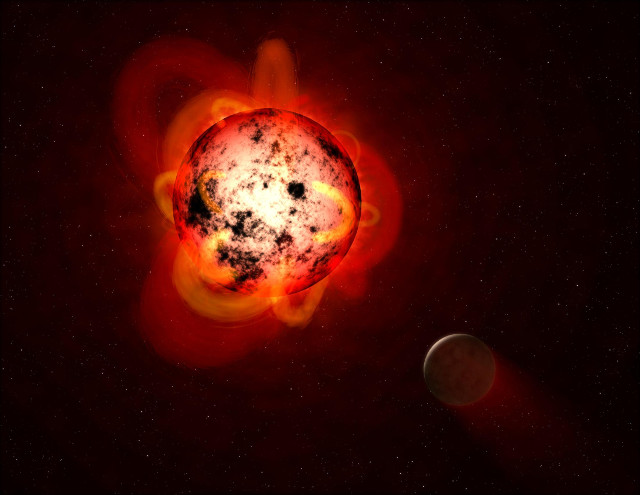
An article published in “The Astrophysical Journal Letters” reports a study on the exoplanet GJ 1252b which concludes that it has no atmosphere. In particular, a team of researchers used data collected by the Spitzer Space Telescope to examine this rocky planet which is about 20% larger than the Earth with a mass that is about 32% larger than the Earth’s. GJ 1252b orbits a red dwarf and according to the researchers, this star stripped this super-Earth’s atmosphere. This is due to the fact that red dwarfs are small but very active stars and confirms that it may be difficult to find a habitable planet around this type of star.
About 66 light-years from Earth, the exoplanet GJ 1252b was discovered thanks to NASA’s TESS space telescope. The follow-up observations that confirmed its existence were reported in an article also published in “The Astrophysical Journal Letters” in February 2020.
The star GJ 1252 is a red dwarf with a size and a mass slightly less than 40% of the Sun’s. It’s the most common type of star in the universe, also because it consumes its hydrogen very slowly and therefore can live even for trillions of years. A lot of research is focusing on red dwarfs to look for exoplanets and they too are proving to be common. However, astronomers are trying to figure out how likely it is that a planet orbiting a red dwarf is habitable, and the characteristics of GJ 1252b offer a pessimistic picture.
The authors of this study especially used observations conducted with the Spitzer space telescope during various passages of the exoplanet GJ 1252b in front of its star. The last observation was conducted a few days before the end of the Spitzer mission, on January 30, 2020. This exoplanet is very close to its star and its year only lasts about 12 hours, so it was possible to conduct 10 observations in a short time.
The analysis of the observations indicates that the exoplanet GJ 1252b has no atmosphere and the temperature on its day side is around 1,400 Kelvin. According to the researchers, GJ 1252b had an atmosphere that was blown away by the activity of its star, as illustrated in the artistic concept of the image (NASA/ESA/STScI/G. Bacon). GJ 1252 is a much smaller star than the Sun but these red dwarfs are very active and their powerful flares can be destructive to the atmospheres of nearby planets.
The situation on GJ 1252b confirms the model that is pessimistic for the search for habitable planets around red dwarfs. However, the search for atmospheres around rocky exoplanets is still in its infancy and a leap forward is expected thanks to the James Webb Space Telescope. A large study will allow understanding if exoplanets a little further away from their star can maintain their atmosphere. Studying many exoplanets of this type will improve existing models and allow to understand how to assess their habitability potential.
