
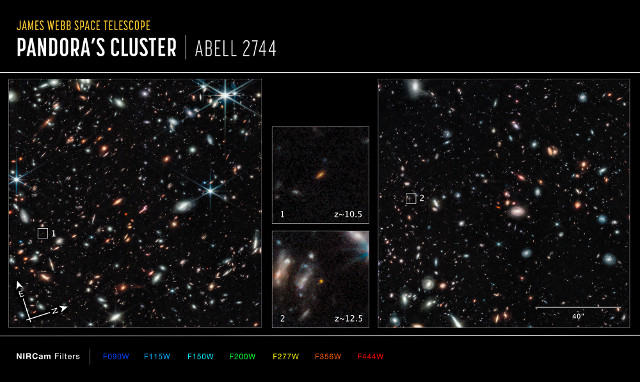
Two articles – available here and here – published in “The Astrophysical Journal Letters” report the results of the analysis of observations of the Abell 2744 galaxy cluster and the surrounding area with the James Webb Space Telescope. Two teams of researchers led respectively by Marco Castellano of the National Institute for Astrophysics in Rome, Italy, and by Rohan Naidu of the Harvard-Smithsonian Center for Astrophysics of MIT examined in particular two very distant galaxies. The galaxy called GLASS-z12 by the second team could be the oldest identified so far because according to estimates, it dates back to 350 million years after the Big Bang. The other galaxy, called GLASS-z10, is estimated to date back to 450 million years after the Big Bang.
The James Webb Space Telescope, launched on December 25, 2021, has among its main purposes the investigation of the early universe in search of the first galaxies. For this reason, it’s not surprising that since the beginning of its scientific activity, it discovered very ancient galaxies but one of them seems to be the oldest known so far. In 2016, the identification of the galaxy GN-z11 was announced, which according to studies dates back to 400 million years after the Big Bang but GLASS-z12 seems even older. There’s also the galaxy HD1, another case still under investigation.
The two galaxies found thanks to the James Webb Space Telescope are shown in the image (Science: NASA, ESA, CSA, Tommaso Treu (UCLA). Image processing: Zolt G. Levay (STScI)): the galaxy cluster Abell 2744, nicknamed Pandora Cluster, with two boxes in the center showing the galaxies GLASS-z10 (1) and GLASS-z12 (2).
Marco Castellano himself revealed the surprise he and his colleagues felt after estimating the ages of those two primordial galaxies. Astronomers predicted they would have to probe a much larger volume of space to find such galaxies. His team was among the first to examine data collected by the James Webb Space Telescope as part of the Grism Lens-Amplified Survey from Space (GLASS), part of Webb’s Early Release Science (ERS) program.
The study by Marco Castellano’s team was the first published with these surprising and extraordinary results. More than ever, it was necessary for the conclusions to be checked, and that’s what happened with the confirmation by Rohan Naidu’s team, whose study is also based on data from the GLASS survey.
There’s still a lot to learn about the universe’s first galaxies. Observations in recent years continue to confirm that they were much brighter than previously thought and also more compact. Their brightness could help the James Webb Space Telescope observe them and may have led to the so quick discovery of GLASS-z12 and GLASS-z10.
Follow-up spectroscopic analyzes of the GLASS-z10 and GLASS-z12 galaxies based on more data obtained with the James Webb Space Telescope will offer other estimates of their ages and information about the stars within them. It’s a complex job but it’s crucial to have some certainty about these two galaxies, also to be able to continue the studies of other primordial galaxies.
