
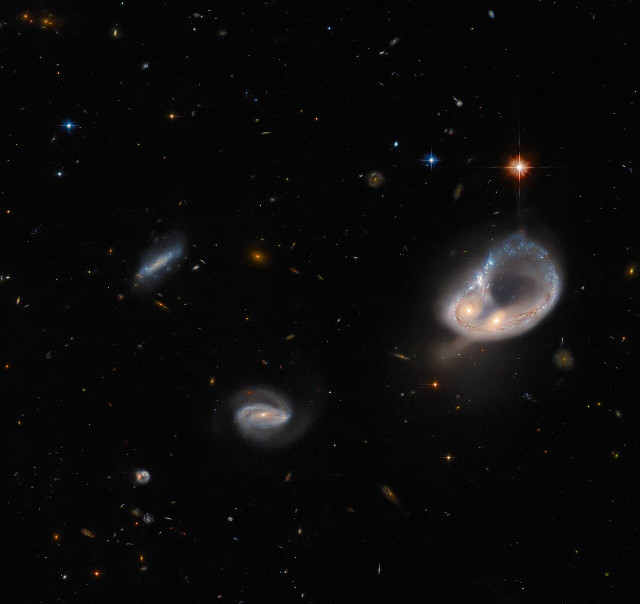
An image captured by the Hubble Space Telescope’s ACS instrument shows Arp-Madore 417-391, or simply AM 417-391, a pair of merging galaxies. It’s part of the Arp-Madore catalog, which collects particularly peculiar galaxies in the southern sky. It includes pairs of galaxies interacting at levels that go up to a merger just like AM 417-391.
The Advanced Camera for Surveys (ACS) instrument is optimized for hunting galaxies and galaxy clusters in the ancient universe. The AM 417-391 pair is “only” 670 million light-years away and makes an excellent object of study for astronomers interested in galaxy mergers.
In the case of AM 417-391, the pair of merging galaxies is visible on the right side of the image (ESA/Hubble & NASA, Dark Energy Survey/DOE/FNAL/DECam/CTIO/NOIRLab/NSF/AURA, J. Dalcanton). The merger has strongly distorted the original shapes of the two galaxies and they have now formed a sort of blue cosmic ring. The cores of the two original galaxies form a bulge on one side of the ring.
Above AM 417-391, a star has almost become the protagonist of a photobombing but luckily it’s distant enough from the galaxy merger not to disturb the study. To the left of the pair, two other smaller spiral galaxies appear but are not interacting with it and will not in the near future.
Every galaxy merger is different because the results are greatly influenced by factors connected to the original galaxies such as their shape, size, relative positions, and speeds at the time they collide. The process causes changes that continue for many millions of years before the new galaxy reaches gravitational equilibrium. In the case of AM 417-391, the interactions generated a giant ring that is blue because new massive stars were born within it. That’s the consequence of the compression of interstellar gas clouds caused by the collision between the two galaxies.
The two cores of the merging galaxies are still distinct, and this indicates that it will still take several million years before the process comes to an end. The Hubble Space Telescope can keep on observing AM 417-391 and this interesting case of galaxy merger can also stimulate observations with other instruments, even new ones such as the James Webb Space Telescope.
