
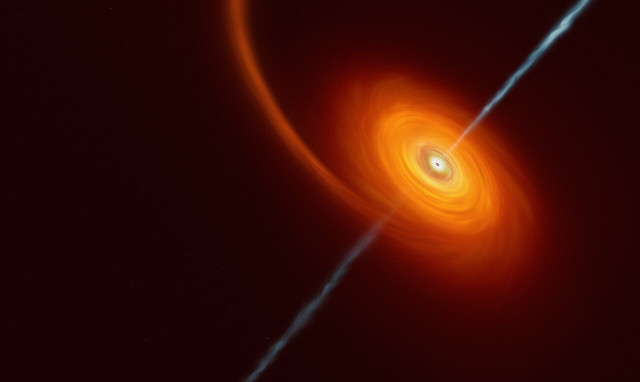
Two articles, one (link to the file in PDF format) published in the journal “Nature” and one in the journal “Nature Astronomy”, report different aspects of the study of the most distant supermassive black hole discovered as it devours a star and then emits a jet of materials accelerated at speeds close to the speed of light. The event, cataloged as AT2022cmc, is somewhat similar to a gamma-ray burst but was detected in various electromagnetic bands thanks to the fact that it’s aimed almost exactly at Earth. This is the first event of its kind detected in visible light, so it can offer new insights into the behavior of truly extreme objects during the destruction of a star that got too close to them.
Tidal disruption events, as the events in which a black hole destroys a star with its enormous tidal forces and then engulfs its pieces are known in jargon, have already been detected on several occasions. The one cataloged as AT2022cmc is the most distant discovered so far since the protagonists are almost 8.5 billion light-years away from Earth.
Another reason for interest in the event cataloged as AT2022cmc is given by the fact that the jet of materials accelerated to relativistic speeds is aimed almost exactly at the Earth. The consequence is that not only was it very bright but the source is also rich in the sense that it contains electromagnetic components in various bands, including visible light.
The discovery of this extraordinary event took place thanks to the detection by the Zwicky Transient Facility (ZTF) of a visible light source in February 2022. Some similarities with a gamma-ray burst led other astronomical observatories to observe the event. The X-shooter instrument mounted on ESO’s VLT (Very Large Telescope) in Chile made it possible to estimate the distance of the source of the jet to be nearly 8.5 billion light-years from Earth.
21 instruments sensitive to very different electromagnetic frequencies ranging from gamma rays to radio waves were used to observe the AT2022cmc event. The team that wrote the article published in “Nature” compared it to various cosmic events but the only one that matched the data collected was a relativistic jet emitted by a supermassive black hole.
The analysis of the collected data led to the reconstruction of the tidal disruption event in which the supermassive black hole is destroying a star that came too close. Gradually, the star’s gas is engulfed by the black hole and some of that material is ejected in the form of jets at the two poles. Normally, these events are discovered thanks to their energetic emissions in the form of X-rays and gamma rays. Only because in this case one of the two jets is aimed almost exactly at the Earth, it was discovered thanks to visible light emissions.
The wealth of data collected thanks to the prompt response of various astronomical observatories offers new information on the processes taking place near supermassive black holes. The published studies are only a phase of broader research on these extreme objects where it’s also possible to test physics models.
