
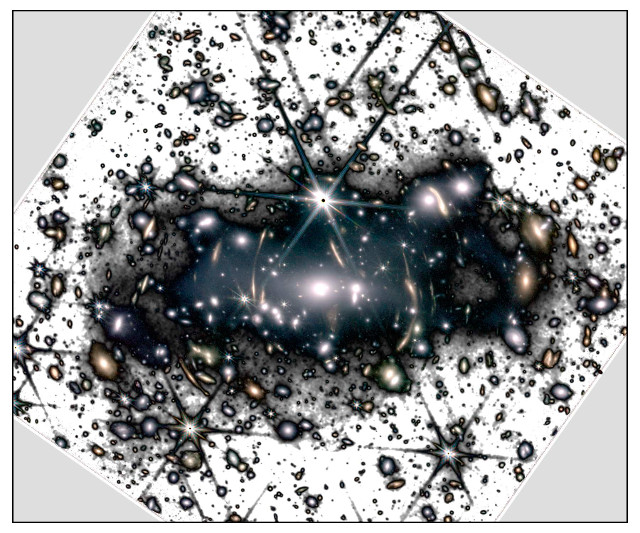
An article published in “The Astrophysical Journal Letters” reports the results of the most complete analysis of the so-called intracluster light conducted so far. Mireia Montes and Ignacio Trujillo of the Instituto de Astrofísica de Canarias (IAC) used the James Webb Space Telescope to observe the SMACS-J0723.3-7327 galaxy cluster. In particular, they exploited the NIRCam instrument to detect intracluster light, which is extremely dim but useful to study galaxy clusters in ways other than visible light observations. These studies are also useful for understanding the distribution of dark matter.
The so-called intracluster light permeates galaxy clusters but is very dim, at brightness levels estimated at around 1% of that of the darkest sky observable from Earth. This is the light of stars that end up in intergalactic space as a result of gravitational interactions between different galaxies. The movements of these stars are determined by the gravitational field within the cluster, mainly generated by dark matter. This makes intracluster light a tracer of its distribution.
Mireia Montes and Ignacio Trujillo have been working for years on this type of mapping of the distribution of dark matter as described in their article published in October 2018 in the journal “Monthly Notices of the Royal Astronomical Society”. At the time, they used observations conducted with the Hubble Space Telescope but now they have been able to exploit the greater possibilities offered by the James Webb.
The results obtained with the new observations of the galaxy cluster SMACS-J0723.3-7327 showed again the extraordinary possibilities of the James Webb Space Telescope. The infrared images obtained thanks to the NIRCam instrument were processed to improve the detection of intracluster light. Analysis techniques, necessary to separate the intracluster light from other sources and to distinguish it from the “noise”, were already created in the past years and were improved to make the most of the new observations.
The image (NASA, ESA, CSA, STScI) shows the result of processing an observation conducted with the James Webb Space Telescope’s NIRCam instrument of the SMACS-J0723.3-7327 galaxy cluster. The intracluster light appears in black and white between galaxies.
Studying intracluster light also offers information about the history of a galaxy cluster. The analysis shows that the inner parts of the SMACS-J0723.3-7327 cluster are forming as a result of a merger of massive galaxies while its outer parts are due to the accretion of Milky Way-like galaxies.
The use of the James Webb Space Telescope opened a new phase of the studies based on intracluster light. They will help reconstruct the history of galaxy clusters and test models of dark matter, including alternative ones that don’t predict its existence.
