
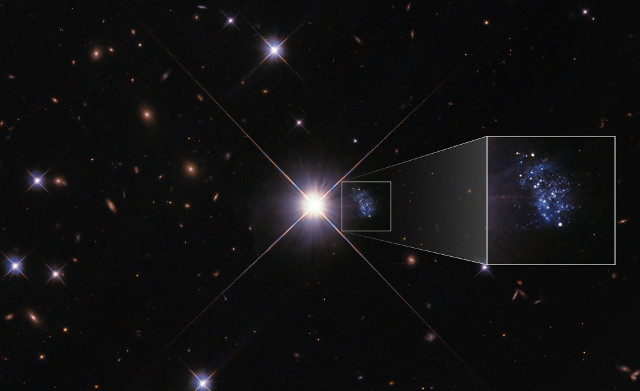
image processing: Alyssa Pagan (STScI))
An article accepted for publication in the journal “Monthly Notices of the Royal Astronomical Society” reports a study of a dwarf galaxy cataloged as HIPASS J1131–31 that is relatively close but has the characteristics of a primordial galaxy. A team of researchers combined observations from various ground-based and space telescopes to confirm its nature, including the Hubble Space Telescope. They nicknamed it Peekaboo because it peeks out from behind a bright star that hid it for a long time and made it difficult to identify. It’s a very small galaxy but its primordial characteristics make it interesting for astronomers.
In astronomical terms, extremely-low metallicity in a galaxy indicates that the stars within it have very limited amounts of elements heavier than hydrogen and helium. In the early universe, extremely metal-poor galaxies were normal but with the passing of generations of stars, the amount of heavy elements generated especially in their cores and in supernovae increased.
Extremely metal-poor galaxies are usually billions of light-years away because we see them as they were when the universe was young. The discovery of a galaxy with an estimated distance of about 22 million light-years with extremely-low metallicity is surprising and interesting.
The detection of the dwarf galaxy officially cataloged as HIPASS J1131–31 is not new given that the first traces were detected over twenty years ago thanks to the Parkes radio telescope in Australia. Bärbel Koribalski of the Commonwealth Scientific and Industrial Research Organisation (CSIRO) was among the discoverers and continued to investigate to understand its nature and characteristics.
The position of the dwarf galaxy HIPASS J1131–31 was an obstacle to its study together with its small size, given that it has an estimated length of “only” 1,200 light-years. Between 50 and 100 years ago, it began to peek out behind a bright star that prevented it from being detected until it moved far enough, hence the nickname Peekaboo.
NASA’s Galaxy Evolution Explorer (GALEX) space telescope showed that Peekaboo was a compact dwarf galaxy with a blue color indicating the presence of massive stars. However, it took years for Bärbel Koribalski and her colleagues to realize just how special it was. It took a combination of instruments to figure out that it’s one of the galaxies with the lowest metallicity detected so far, a surprising result considering that it is “only” 22 million light-years away from Earth.
The Hubble Space Telescope made it possible to identify about 60 stars inside Peekaboo, almost all young with an age up to a few billion years. The Southern African Large Telescope (SALT) made it possible to measure their metallicity, and that stressed the difference between this dwarf galaxy and other galaxies in the local universe, which contain ancient stars that show their age.
Peekaboo is not unique in its very low metallicity and small size. AGC 198691, nicknamed Leoncino, is another dwarf galaxy about 41 million light-years from Earth but also relatively close. In both cases, the extremely-low metallicity has no explanation and for this reason, these two tiny galaxies are of astronomical interest. The researchers studying Peekaboo plan to conduct further observations with the Hubble Space Telescope and also with the James Webb Space Telescope to obtain more information about the stars within it.
