
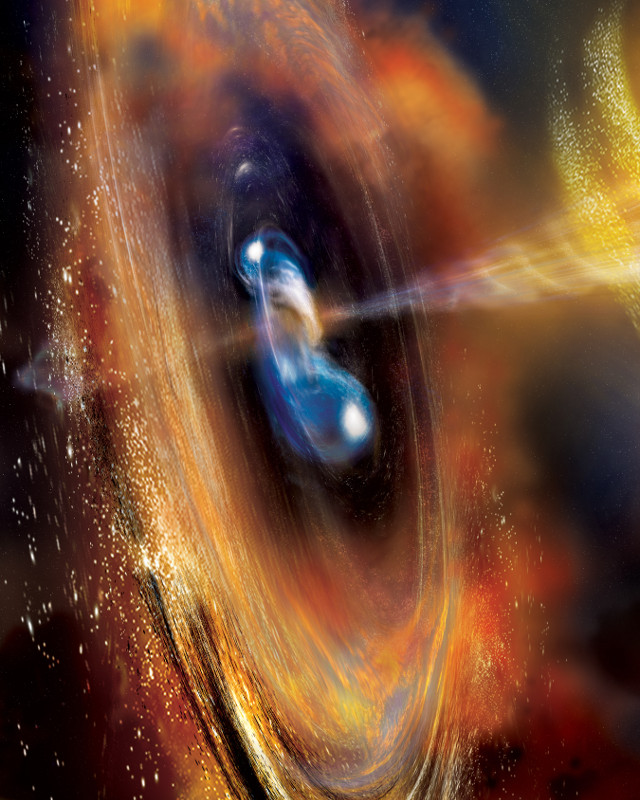
Three articles – available here, here, and here – published in the journal “Nature” and one article published in the journal “Nature Astronomy” report various aspects of the studies conducted on the out-of-normal gamma-ray burst cataloged as GRB 211211A. Various teams of researchers used observations conducted with a series of ground-based and space telescopes to examine an event that lasted more than two hours after the actual burst. At that time, the gravitational wave detectors were not active but the event’s characteristics indicate that the origin is in a kilonova, a merger between two neutron stars.
On December 11, 2021, NASA’s Swift Space Telescope detected a gamma-ray burst. These extremely energetic events can be very short or last longer than a minute and have different origins. A long-lasting gamma-ray burst is particularly interesting and in this case, cataloged as RGB 211211A, once it was finished, the Fermi Space Telescope continued to detect high-energy gamma rays for over two hours in an emission called in jargon the afterglow.
Studies of kilonovas conducted in recent years, also thanks to gravitational wave detections, indicate that this type of event generates a short-lived gamma-ray burst, while long-lasting ones are generally associated with supernovae, explosions of stars. However, observations conducted with instruments sensitive to X-rays and radio waves formed a picture of a kilonova, the merger of two neutron stars.
Duration of the gamma-ray burst aside, the emissions were very similar to those of the kilonova associated with the detections of gravitational waves cataloged as GW 170817. That was a historic event because it was detected at both gravitational waves and electromagnetic waves. Follow-up observations in the area of origin of the gamma-ray burst RGB 211211A, about one billion light-years from the Earth, conducted in the following days with various telescopes including the Hubble Space Telescope, confirmed that the characteristics of the event are those of a kilonova.
The length of the gamma-ray burst RGB 211211A and the length of the gamma emissions of the afterglow are a mystery. For now, there are only a few hypotheses to be verified. On the bright side, this event expands our understanding of kilonovas and shows that they can generate long gamma-ray bursts too. Research on these very energetic events is complex with a long time for analyzes and comparisons between the various cases. The progress in gravitational-wave astronomy will help study kilonovas, where heavy elements such as gold are generated.
