
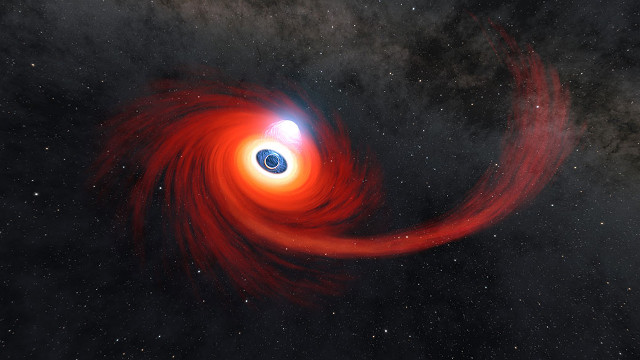
An article published in “The Astrophysical Journal” reports the results of the observations of a supermassive black hole that is destroying a star. Cataloged as AT2021ehb, this is an event of the type technically called a tidal disruption event. A team of researchers used observations conducted with NASA’s NuSTAR and Swift space telescopes, the NICER instrument on the International Space Station, and other instruments to cover 430 days of the evolution of this process. This will help understand what happens to materials captured by a supermassive black hole before they’re completely swallowed.
Several cases of stars being destroyed by black holes have been discovered. They’re considered cosmic laboratories which, thanks to the energies emitted in the form of electromagnetic waves, offer information on what happens when a black hole devours materials that get too close. In the case of the tidal disruption event AT2021ehb, it’s a supermassive black hole with an estimated mass of around 10 million times the Sun’s at the center of a galaxy approximately 250 million light-years from Earth.
The detection of the AT2021ehb event was made by the Zwicky Transient Facility (ZTF) installed at the Palomar Observatory, which scans the northern sky every two days in search of new cosmic events as part of an international collaboration. This made it possible to begin monitoring using the Swift Space Telescope and the NICER instrument, designed to study neutron stars by detecting longer X-ray wavelengths than Swift. More data was collected using other instruments, and that was just the beginning.
About 10 months after the detection of the event, the NuSTAR space telescope began observing the AT2021ehb event. At this point, the detection of a corona in the sense of a very hot plasma cloud was achieved. This came as a surprise because black holes typically emit this type of ionized gas in the form of jets at the poles while in this case, there was no sign of them. Essentially, X-rays were detected emitting from the corona at higher energies than in other parts of the black hole but scientists don’t know where the plasma that generated them comes from or why that plasma is so hot.
The star captured by the supermassive black hole suffered the very powerful gravitational forces: its side closest to the black hole was attracted with greater force than its far side causing what is called spaghettification because the object is stretched like spaghetti.
According to the researchers, the shape of the corona is linked to the magnetic fields around the supermassive black hole but further studies are needed to understand why they become so intense and why it doesn’t generate jets at the poles. The AT2021ehb event is providing new insights into what happens to materials captured by a black hole and the ongoing processes will continue to be studied to better understand what happens in those extreme environments.
