
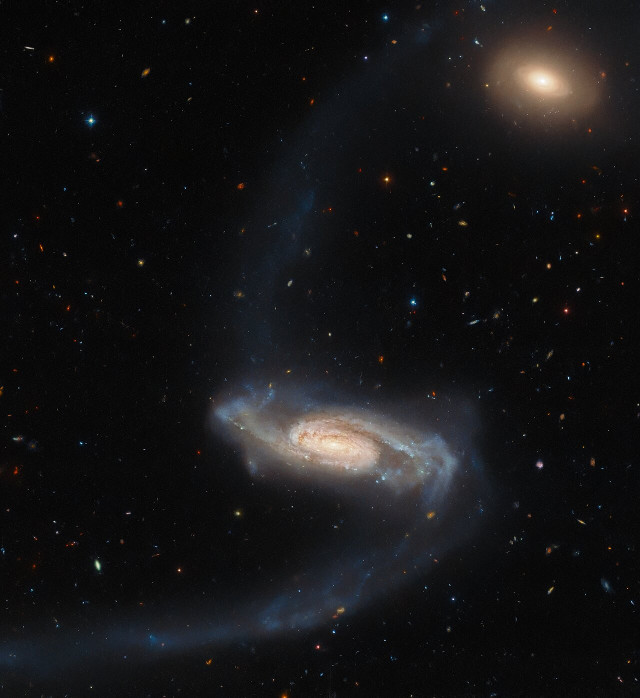
An image captured by the Hubble Space Telescope shows the galaxy ESO 415-19 and its long arms, making it a decidedly unusual spiral galaxy. It’s a spiral galaxy but was included in the Atlas of Peculiar Galaxies due to the extraordinary extension of its arms. So far, no other traces of the cosmic interaction that caused this anomaly in ESO 415-19 have been found but its peculiarity made it an interesting object of observation with Hubble and other instruments. For publication, photos taken with Hubble’s ACS instrument were combined with others captured with the DECam camera on the Victor M. Blanco telescope.
About 450 million light-years from Earth, the galaxy ESO 415-19, also known as LEDA 8936 or IRAS F02188-3210, is in many ways an ordinary spiral galaxy and must have looked like many other galaxies of this class in the past. At some point, there must have been an interaction with another galaxy that distorted its arms with its gravity.
The consequences of an interaction between galaxies depend on the mass, the relative speed between them, and their trajectories. Mergers between galaxies are common but in other cases, their gravity is not strong enough to lead to the merger. In those cases, their shape remains more or less distorted for a very long time. Perhaps, ESO 415-19 crossed paths with a dwarf galaxy that “only” managed to elongate its arms, which now stretch to very rarefied ends that contain few scattered stars. Instead, the galactic core seems to have remained as before, or perhaps the distortion was minimal and returned to the previous balance.
The published image is the result of a combination of various photos taken with the Hubble Space Telescope’s ACS (Advanced Camera for Surveys) instrument and others taken with the DECam camera on the Victor M. Blanco telescope in Chile. All filters used are at optical frequencies, which means that they’re part of visible light.
Each interaction between galaxies is different and therefore has different consequences. The observations of ESO 415-19 are part of a campaign to study the galaxies included in the Atlas of Peculiar Galaxies that aims to examine those consequences. In some cases, gravitational interactions can tear stars from a galaxy, and those at the ends of ESO 415-19’s arms remained barely bound to their galaxy. The fate of many stars and their planets is linked to these cosmic “accidents”.
