2022

A portion of Pluto's surface in grayscale with an artistic interpretation of how cryovolcanic processes may have operated indicated in blue

An article published in the journal “Nature Communications” reports a study on the activity of cryovolcanoes existing on the dwarf planet Pluto which highlights how it has continued until recent times from a geological point of view and may still be present. A team of researchers led by Kelsi Singer of the Southwest Research Institute used data collected by NASA’s New Horizons space probe to examine the marks left by cryovolcanoes in the Sputnik Planitia region, in the large heart-shaped area on the surface. One conclusion is that Pluto has an underground heat source that kept it geologically active much longer than might be expected from a dwarf planet.


Earendel, indicated by an arrow, seen by Hubble (Image NASA, ESA, B. Welch (JHU), D. Coe (STScI), A. Pagan (STScI) )

An article published in the journal “Nature” reports the discovery of the most distant single star, nicknamed Earendel. A team of researchers used data collected during the RELICS (Reionization Lensing Cluster Survey) program using the Hubble Space Telescope to search for the brightest galaxies dating back to the first billion years of the universe’s life. A large galaxy cluster cataloged as WHL0137-08 distorted the image of very distant galaxies in a gravitational lensing effect to the point that it can detect a single star about 12.9 billion light-years away from Earth. Earendel’s study, whose mass was estimated to be at least 50 times the Sun’s, will help to better understand the formation and evolution of the very first generations of stars in the universe.

The Soyuz MS-19 spacecraft leaves the International Space Station (Image NASA TV)

A little while ago, cosmonauts Anton Shkaplerov and Pyotr Dubrov and astronaut Mark Vande Hei returned to Earth on the Soyuz MS-19 spacecraft, which landed in Kazakhstan. Shkaplerov spent nearly 6 months on the International Space Station, where he arrived on October 5, 2021, as part of Expedition 65. Dubrov and Vande Hei arrived on April 9, 2021, as part of Expedition 64 and completed a long-duration mission.

The star V Hydrae and its rings seen by ALMA (Image ALMA (ESO/NAOJ/NRAO)/S. Dagnello (NRAO/AUI/NSF))

An article accepted for publication in “The Astrophysical Journal” reports the results of a study of the star V Hydrae that includes the discovery of a system of six rings that surround it and are expanding and two hourglass structures. A team led by Raghvendra Sahai of NASA’s JPL used the ALMA radio telescope and data collected with the Hubble Space Telescope to study the materials that were ejected by V Hydrae in the agony that will lead to its death. These observations can provide valuable information to better understand the processes taking place during a relatively short phase that for this reason is difficult to observe.

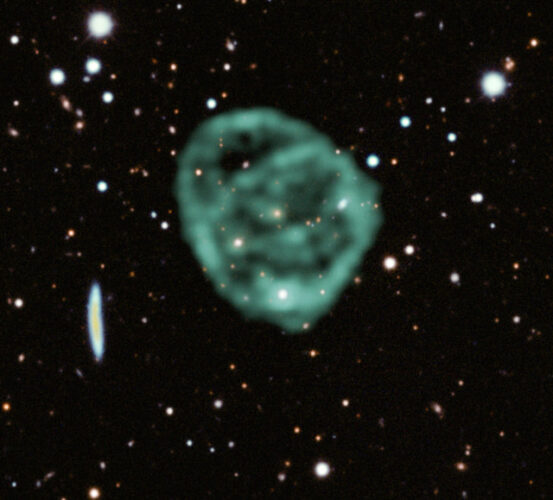
ORC1 seen by MeerKAT and in the background optical data from the Dark Energy Survey (Image J. English (U. Manitoba)/EMU/MeerKAT/DES(CTIO))

An article published in the journal “Monthly Notices of the Royal Astronomical Society” reports a study based on a new image of a so-called odd radio circle (ORC). A team of researchers used the MeerKAT radio telescope to observe this structure with a diameter of over one million light-years visible only at radio waves. Each new observation of this type of phenomenon offers new information, as only five of them are known at the moment. The information collected with MeerKAT could help verify the theories that were proposed and reach a reasonably certain explanation for its origin and nature.