2022

Artist's concept of the exoplanet Wasp-103b and its star (Image ESA)

An article published in the journal “Astronomy & Astrophysics” reports a study of the exoplanet Wasp-103b that offers evidence of its oval shape. A team of researchers used data collected by ESA’s CHEOPS space telescope to have the accuracy needed to assess this gas giant’s anomalous shape. It’s due to its star’s powerful tidal forces, as the star is a bit larger and more massive than the Sun, on this planet due to their proximity. In fact, Wasp-103b is so close to its star that its year lasts a little less than an Earth day.

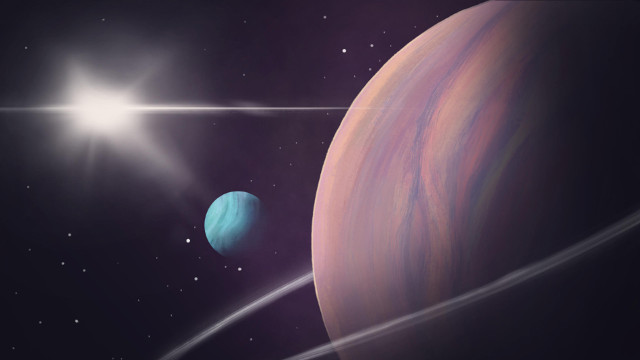
Artist's concept of the exoplanet Kepler-1708 b with its moon (Image courtesy Helena Valenzuela Widerström)

An article published in the journal “Nature Astronomy” reports the discovery of an exomoon candidate that was cataloged as Kepler-1708 b-i. A team of researchers led by David Kipping of Columbia University analyzed data collected by NASA’s Kepler Space Telescope with the specific purpose of looking for possible moons around exoplanets discovered thanks to Kepler. The Jupiter-sized gas giant Kepler-1708 b has a signal indicating the possible presence of a moon that would be a little smaller than the planet Neptune.

Jupiter's North Pole with eight cyclones surrounding a central cyclone

An article published in the journal “Nature Physics” describes similarities between the cyclones present at the planet Jupiter’s poles and the vortices existing in the Earth’s oceans. A team of researchers used images captured by NASA’s Juno space probe of Jupiter cyclones to study them, compare them with similar ocean phenomena, and describe them by applying geophysical fluid dynamics. The conclusion is that Jupiter cyclones are also produced and continue their existence thanks to convection phenomena that lead masses of hot gas to rise and then cool down and descend again into the deeper layers of the Jovian atmosphere.

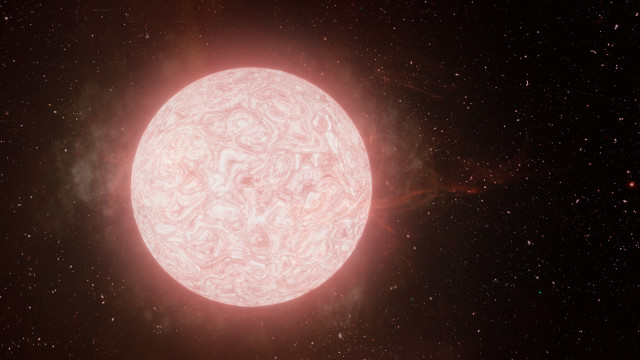
Artist's concept of a red supergiant star exploding (Image courtesy W.M. Keck Observatory/Adam Makarenko)

An article published in “The Astrophysical Journal” reports the observations of the supernova cataloged as SN 2020tlf, the first case in which astronomers observed a red supergiant star in the period immediately preceding the explosion. A team of researchers used the Pan-STARRS telescope in Hawaii to detect the changes taking place in the red supergiant in the summer of 2020 and then used the NIRES and DEIMOS instruments of the Keck Observatory, also in Hawaii, for the first spectrographic detections of the supernova emissions in the fall of 2020. Subsequently, other instruments added data on the supernova. Astronomers expected a red supergiant to go through a quiet period before exploding, but SN 2020tlf’s progenitor emitted strong radiation in the last year of its life.

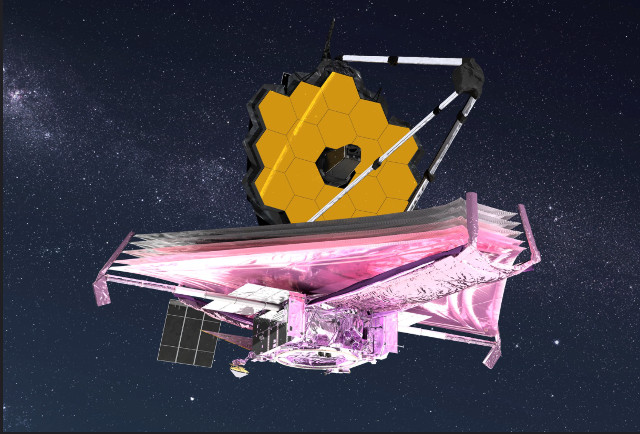
Illustration of the James Webb Space Telescope (Image NASA GSFC/CIL/Adriana Manrique Gutierrez)

Yesterday, NASA confirmed the successful completion of the deployment of all components of the James Webb Space Telescope. Launched on December 25, 2021, this next-generation space telescope required several days of complex operations to deploy the various structures that make it up to reach its final configuration. This was a crucial phase that also included risks in the event that one of the systems didn’t work properly. Now the new phase opens with the calibration of the instruments, task-intensive to the point that it will take months before the James Webb can finally begin its scientific mission.