2022

The Cygnus "Sally Ride" cargo spacecraf captured by the International Space Station's Canadarm2 robotic arm (Image NASA TV)

Northrop Grumman’s Cygnus spacecraft, launched last Monday, November 7, has just reached the International Space Station and was captured by the Canadarm2 robotic arm. Astronaut Nicole Mann, assisted by her colleague Josh Cassada, will soon begin the slow maneuver to move the Cygnus until it docks with the Station’s Unity module after about two hours.

The Cygnus "Sally Ride" cargo spacecraft blasting off atop an Antares rocket (Image NASA TV)

A little while ago, Northrop Grumman’s Cygnus spacecraft blasted off atop an Antares rocket from the Mid-Atlantic Regional Spaceport (MARS), part of NASA’s Wallops Flight Facility (WFF) on Wallops Island. After about nine minutes it successfully separated from the rocket’s last stage and went en route to its destination. This is the mission called NG-18 or CRS NG-18 to transport supplies to the International Space Station for NASA.

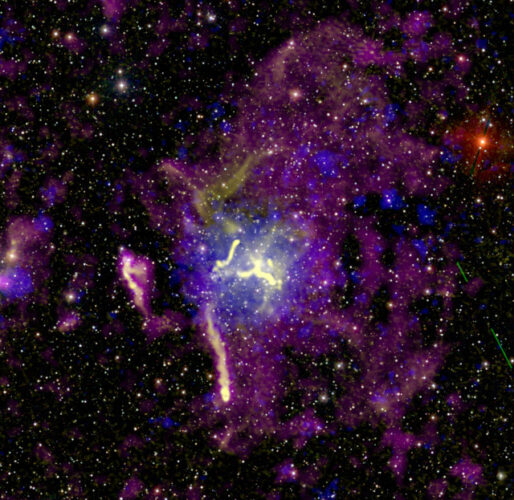
A composite view of the galaxy cluster Abell 2255

An article published in the journal “Science Advances” reports the results of a study of the galaxy cluster Abell 2255 which for the first time detected a radio glow on a scale so large that it surrounded the entire cluster. A team of researchers used the LoFar radio telescope for 18 nights over an area four times the size of the full moon to achieve such a detailed result. According to the researchers, the origin of that emission which is at least 16 million light-years wide is linked to the energy released during the cluster formation.

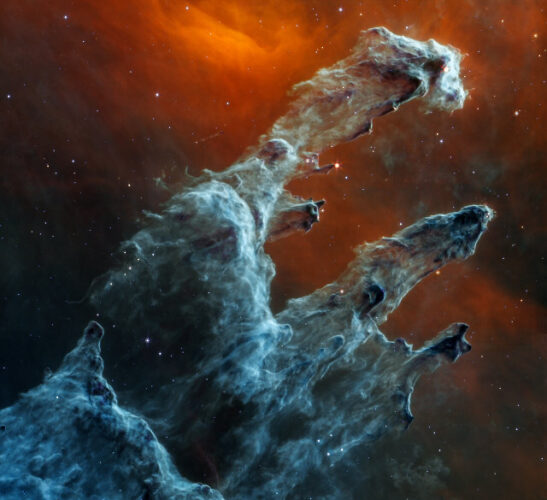
The Pillars of Creation as seen by the James Webb Space Telescope's MIRI instrument (Image NASA, ESA, CSA, STScI, J. DePasquale (STScI), A. Pagan (STScI))

A new image of the so-called Pillars of Creation was released, once again captured by the James Webb Space Telescope. It follows an image published a few days ago yet they show a landscape that looks very different with regards to the background of the structures that gave this star-forming area its nickname. This is due to the fact that this image was captured using the Mid-Infrared Instrument (MIRI), which sees in the mid-infrared, while the previous one was captured using the Near-Infrared Camera (NIRCam), which sees in the near-infrared. The different views offer a combination of information that is very useful in studying the gas and dust clouds in which there are young stars and others in the process of forming.

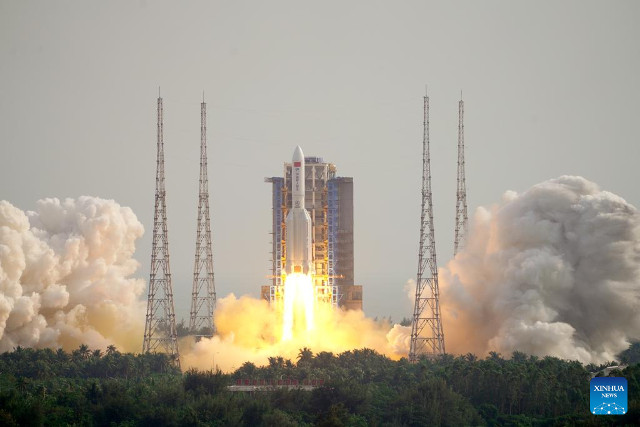
The Mengtian module blasting off on a Long March-5B rocket (Photo courtesy Xinhua/Guo Zhongzheng)

Confirmation arrived that the Mengtian module successfully completed docking maneuvers with the Chinese Tiangong space station’s Tianhe core module. Mengtian was launched about 13 hours earlier from the Wenchang base on a Long March-5B rocket. A few hours after docking, the Shenzhou-14 mission taikonauts, as the Chinese call their astronauts, entered the new module. This success represents the completion of the first phase of the Chinese space station construction, as now it’s formed by the core module Tianhe and two laboratories after the Wentian reached orbit on July 24.