2022

The Progress MS-21 cargo spacecraft blasting off atop a Soyuz rocket (Image NASA TV)

A few hours ago, the Progress MS-21 spacecraft blasted off atop a Soyuz-2.1a rocket from the Baikonur Cosmodrome in Kazakhstan. After about nine minutes it successfully separated from the rocket’s last stage and was placed on its route. The cargo spacecraft began its resupply mission to the International Space Station also called Progress 82 or 82P. In this mission, the route used is the one that requires about two days.

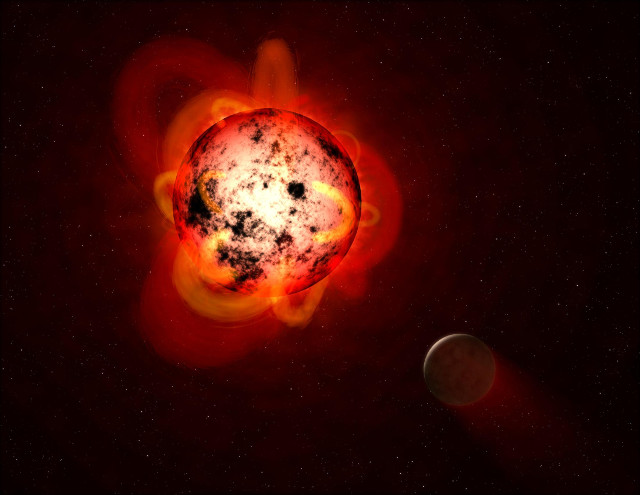
Artist's concept of a rocky planet's atmosphere being stripped by a red dwarf's flares

An article published in “The Astrophysical Journal Letters” reports a study on the exoplanet GJ 1252b which concludes that it has no atmosphere. In particular, a team of researchers used data collected by the Spitzer Space Telescope to examine this rocky planet which is about 20% larger than the Earth with a mass that is about 32% larger than the Earth’s. GJ 1252b orbits a red dwarf and according to the researchers, this star stripped this super-Earth’s atmosphere. This is due to the fact that red dwarfs are small but very active stars and confirms that it may be difficult to find a habitable planet around this type of star.

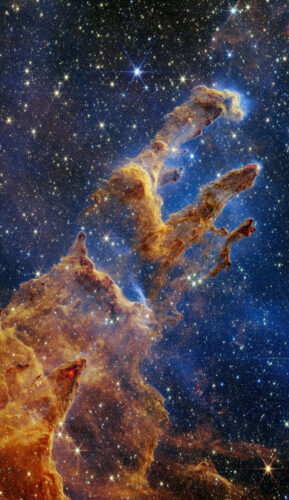
The Pillars of Creation seen by James Webb Space Telescope (Image NASA, ESA, CSA, STScI; J. DePasquale, A. Koekemoer, A. Pagan (STScI))

The so-called Pillars of Creation have been portrayed in some of the iconic images captured by the Hubble Space Telescope. Now the James Webb Space Telescope obtained even more detailed views of that star-forming area that is part of the Eagle Nebula. Webb’s infrared sensitivity can see even inside dust clouds where there are newborn stars and areas where stars are forming. That hasn’t only made it possible to obtain even more spectacular photos but also to provide a lot of new information useful to improve the models concerning star formation.

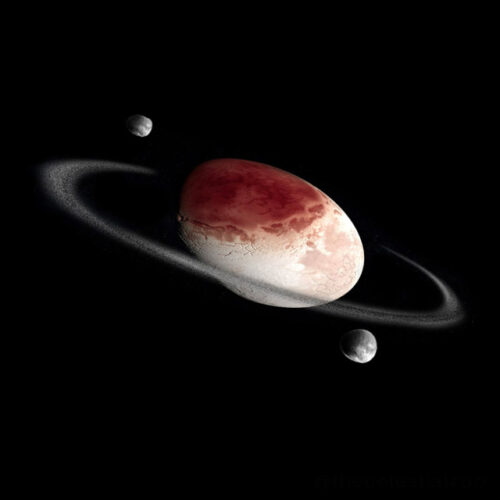
An artistic representation of Haumea with its moons Hiʻiaka and Namaka, which are actually much farther away from it, and its ring

An article published in the “Planetary Science Journal” reports the results of simulations that reproduce the possible history of the dwarf planet Haumea that led to its peculiar oval shape. A team of researchers used the geophysical and geochemical data available on Haumea and the asteroids that form a family with this dwarf planet to understand what processes led to their formation and evolution. The simulations lead to a reconstruction of the process that resulted in Haumea’s remarkable fast spin, which in turn led to its present shape.