2022

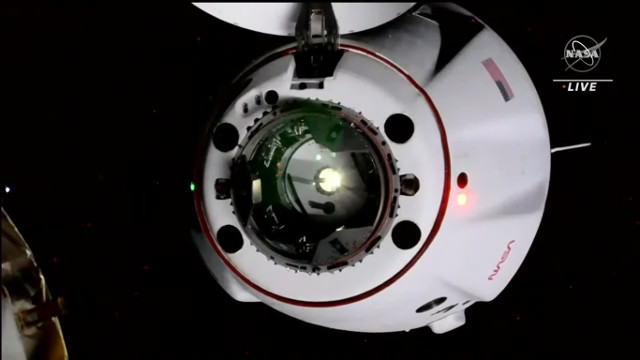
The Crew Dragon Endurance spacecraft approaching the International Space Station in its Crew-5 mission (Image NASA TV)

A few hours ago, SpaceX’s Crew Dragon Endurance spacecraft docked with the Harmony module of the International Space Station completing the first part of its Crew-5 or SpaceX Crew-5 mission that began with its launch about 29 hours earlier. After checking that the pressure was properly balanced, the hatch was opened to allow Koichi Wakata, Nicole Mann, Josh Cassada, and Anna Kikina to enter the Station.

SpaceX's Crew Dragon Endurance spacecraft blasting off atop a Falcon 9 rocket in its Crew-5 mission (Image NASA TV)

A little while ago, SpaceX’s Crew Dragon Endurance spacecraft blasted off atop a Falcon 9 rocket from the Kennedy Space Center in its Crew-5 or SpaceX Crew-5 mission. After almost exactly twelve minutes, it successfully separated from the rocket’s last stage and went en route to carry out its mission. This is the 5th crewed mission of the Crew Dragon spacecraft within the normal rotation of the International Space Station crew. This is also the second mission for the Endurance.

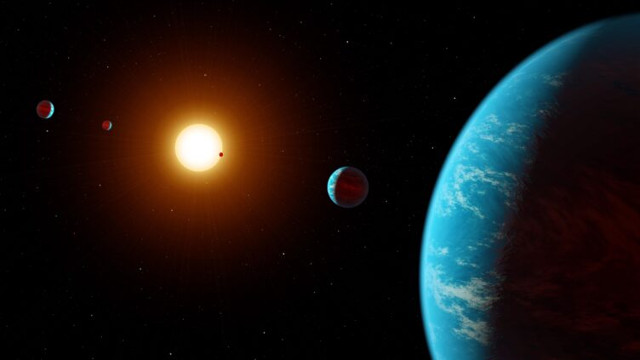
Artist's concept of a 5-Exoplanet system (Image NASA/JPL-Caltech))

An article published in the journal “Astronomy & Astrophysics” reports the confirmation of the presence of 5 rocky planets in the HD 23472 star system. A team of researchers used the Espresso spectrograph on ESO’s VLT to examine these exoplanets to estimate their masses using the radial velocity method. Their sizes were already known thanks to the data collected by NASA’s TESS space telescope, which observed their transit in front of their star. The result of the examination is that three of those exoplanets are super-Earths and two are probably super-Mercuries, rare cases characterized by a larger iron core and in general a high percentage of iron.

A topographic map of Ultimi Scopuli's area on Mars

An article published in the journal “Nature Communications” offers new confirmation of the presence of very salty liquid water on Mars underground. A team of researchers led by Roberto Orosei of the Italian National Institute of Astrophysics and Elena Pettinelli of the Italian Roma Tre University examined detections conducted with ESA’s Mars Express space probe’s MARSIS instrument together with laboratory experiments and simulations to rule out that the data collected were generated by materials other than salty liquid water.

The Soyuz MS-21 spacecraft departing the International Space Station (Image NASA TV)

A little while ago, cosmonauts Oleg Artemyev, Denis Matveev, and Sergey Korsakov returned to Earth on the Soyuz MS-21 spacecraft, which landed in Kazakhstan. They spent just over 6 months on the International Space Station, where they arrived on March 18, 2022, as part of Expedition 66.

On Wednesday, September 28, Oleg Artemyev officially handed over the command of the International Space Station to Italian astronaut Samantha Cristoforetti, marking the start of Expedition 68.