
A violent volcanic outburst was detected on Jupiter’s moon Io by Jeff Morgenthaler using the Io Input/Output observatory (IoIO) at the Planetary Science Institute (PSI). The scientist of this non-profit organization based in Arizona has been monitoring Io since 2017, observing several outbursts but the one in autumn 2022 was the most violent. This monitoring can also be useful for the mission of NASA’s Juno space probe, in orbit around Jupiter, as NASA is planning a Io flyby in December 2023 in which its instruments will be able to carry out measurements of the emitted gases such as sodium and ionized sulfur.
The IoIO instrument was built by assembling components of commercial telescopes and cameras that are normally found in shops but still offers very interesting results from a scientific point of view. Its main purpose is to monitor Io, the most geologically active body in the solar system. This activity takes the form of volcanic outbursts and is caused by gravitational forces acting on Io from Jupiter but also from the other Galilean moons.
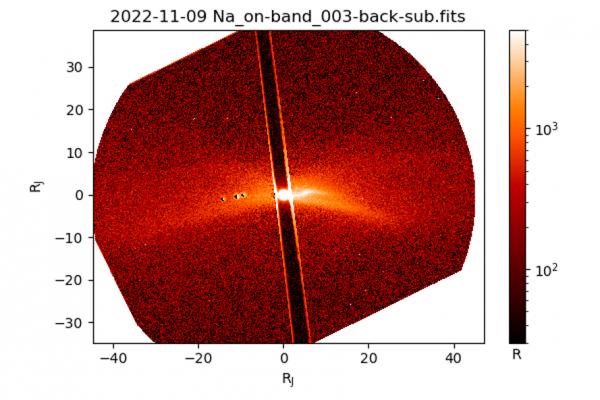
A coronagraphic technique is used to dim Jupiter’s brightness and allow the IoIO instrument to capture images of the gases emitted by Io during its many volcanic outbursts. Every year, some particularly violent outbursts are detected but the one in 2022 was more violent than the previous ones. Sodium and ionized sulfur showed traces that were still dim but brighter than normal between July and September 2022 and lasted until December. The image (Courtesy Jeff Morgenthaler, PSI. All rights reserved) shows an image captured by the IoIO instrument on November 9, 2022, showing the sodium nebula emissions from the outburst originating from Io.
Ionized sulfur is the element that showed the greatest long-term consequences in the Jovian system. Its emissions formed a donut-shaped structure around Jupiter that is technically called a torus, in this case, the Io plasma torus. The surprise came from the fact that this torus is much dimmer than the structures that formed in recent years on the occasion of previous violent outbursts. This could be related to the composition of the volcanic activity or the torus could be more efficient at shedding materials when larger quantities of materials are thrown into it.
Emissions from Io’s volcanoes also generate an atmosphere, albeit a tenuous one, on this moon, composed mostly of sulfur dioxide. It collapses when Io enters Jupiter’s shadow and the gas freezes because it’s no longer warmed up by the Sun. The study of these processes involving Jupiter and its moon is among NASA’s Juno space probe’s mission goals but the monitoring of Io’s volcanic activity is conducted from Earth.
Jeff Morgenthaler explained that having other copies of the IoIO instrument in other places could increase the time of that monitoring. PSI is supported by NASA and by donations that can also come from individual amateur astronomers which could allow the extension of works such as the monitoring of the volcanoes of Io.
